Illinois Drought Deepens as Peoria and Bloomington Need Over 8 Inches of Rain in One Month to Recover
ILLINOIS — A significant rainfall deficit continues across parts of central Illinois, with new data showing that cities like Peoria and Bloomington would need more than 8 inches of rain in just one month to eliminate current drought conditions — and more than 15 inches over three months for full recovery.
How Much Rain Is Needed to End the Drought?
According to the latest regional analysis, drought recovery in central Illinois will require sustained, above-normal rainfall rather than one or two storm systems. The data shows that within a one-month period, several areas would need dramatic rainfall totals to fully erase deficits.
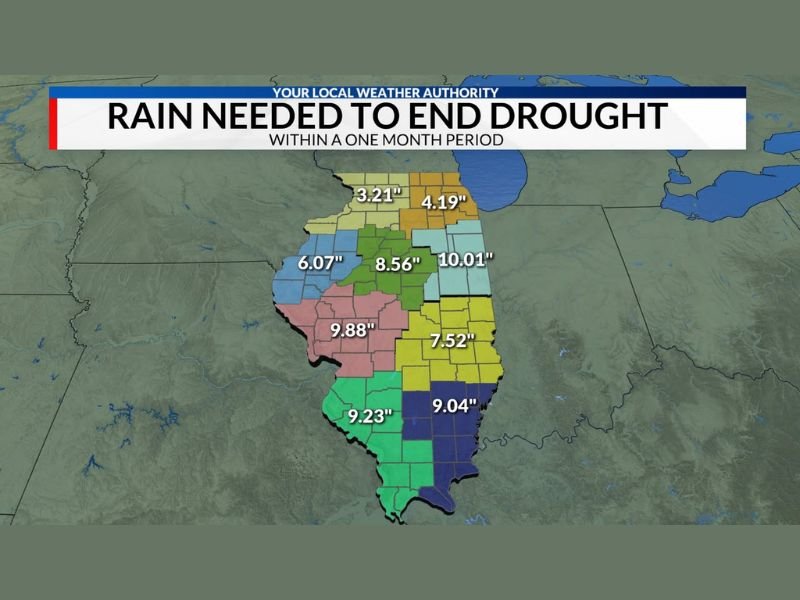
Northern Illinois counties are showing deficits of around 3.21 inches to 4.19 inches, while central sections range from 6.07 inches to 8.56 inches. Eastern portions of the state show a deficit near 10.01 inches, indicating more severe dryness.
In the Peoria and Bloomington corridor, the situation is especially concerning. Meteorologists note that the region would need over 8 inches of rain in a single month, and more than 15 inches within three months, to fully reverse drought impacts.
Central and Southern Illinois Facing Higher Deficits
Moving southward, rainfall needs become even more substantial. Portions of west-central Illinois show a deficit of 9.88 inches, while southwestern counties are near 9.23 inches. Southeastern Illinois is currently running about 9.04 inches below normal, and some east-central counties show a need for roughly 7.52 inches to break drought status.
These numbers highlight a widespread and persistent moisture shortfall across much of the state. The graphic titled “Rain Needed to End Drought Within a One Month Period” () illustrates how uneven rainfall distribution has been across Illinois, with central and southern counties requiring significantly more precipitation compared to the northern tier.
Why One Storm Won’t Fix It
While forecast patterns suggest the overall weather setup may become more active in the coming weeks and months, meteorologists caution that drought relief will not happen quickly.
It would take multiple widespread soaking rain events, spaced closely enough together to replenish soil moisture, improve streamflow levels, and recharge groundwater supplies. A single heavy rainfall event may temporarily improve surface conditions but will not eliminate long-term deficits.
In addition, colder-season precipitation events often produce lighter totals compared to warm-season convective storms, making rapid recovery even less likely in the short term.
Long-Term Pattern Shift Possible
Forecasters indicate the pattern may gradually turn more active as we move deeper into late winter and early spring. That could increase the frequency of storm systems tracking across the Midwest.
However, experts stress that drought recovery is typically a multi-month process, especially when deficits exceed 8 to 10 inches. Even with a wetter pattern developing, consistent rainfall over time will be required to make meaningful improvements.
For communities in Peoria, Bloomington, and surrounding counties, the focus now shifts toward watching whether upcoming storm systems can begin to chip away at the rainfall deficit. If you are seeing dry soil, low pond levels, or other drought impacts in your area, share your conditions with us at CabarrusWeekly.com and let our weather desk know what you’re experiencing.