California, Arizona, Texas, Oklahoma, Kansas, and 12 More States Shatter All-Time March Temperature Records in Historic Heatwave That Experts Call Rarer Than a 1,000-Year Event
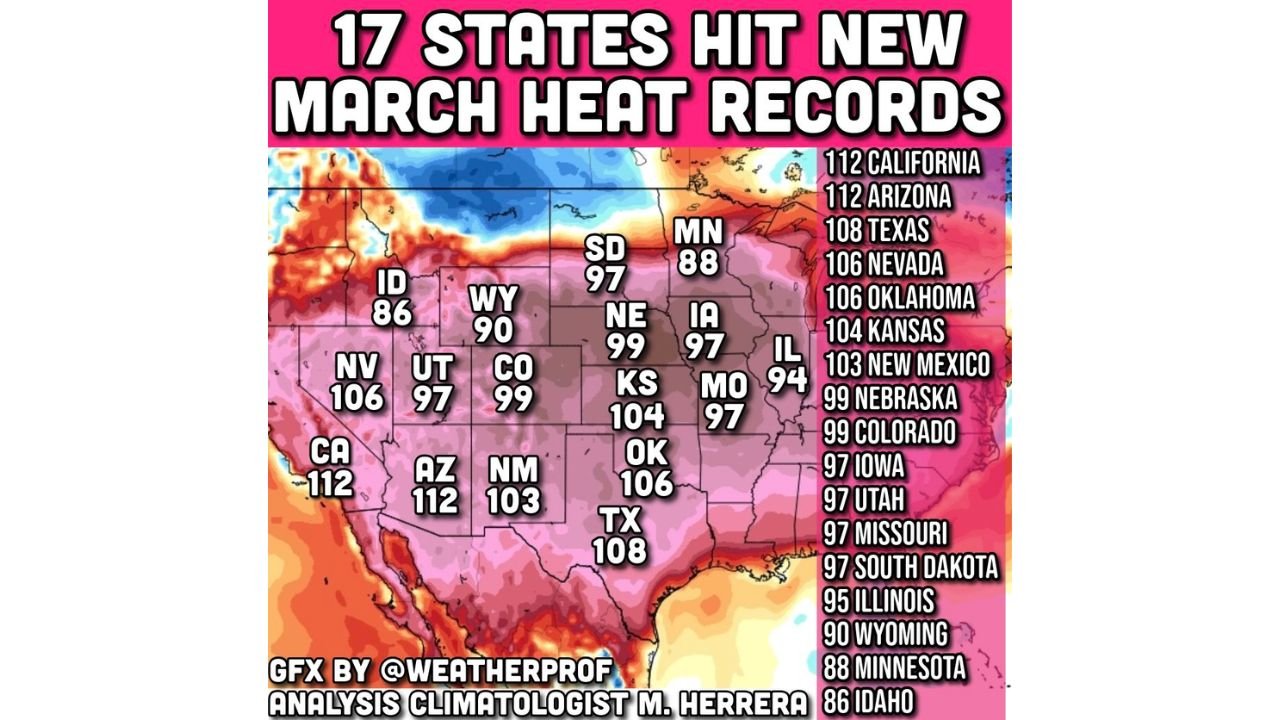
UNITED STATES — As March 2026 comes to a close, the full scale of one of the most extraordinary heat events in American recorded history is becoming clear. 17 states across the West, Southwest, Plains, and Midwest have set new all-time March maximum temperature records over the last 10 days — a heatwave so severe that climate researchers are calling it rarer than a 1,000-year event when its intensity, longevity, and geographic size are considered together.
In total, NOAA recorded more than 15,000 daily city heat records across the United States in March 2026, along with approximately 3,000 monthly city heat records — numbers that have no parallel in the historical record for this time of year.
How Unprecedented Was This Heatwave
The word unprecedented gets used loosely in weather coverage. This event earns it.
A 1,000-year event means that statistically, a heat event of this magnitude would be expected to occur only once every thousand years based on historical climate data. When you factor in not just the peak temperatures but the duration of the heat, the geographic footprint it covered, and the intensity across all three factors simultaneously, this event exceeds even that threshold.
Meteorologists simply did not think a March heatwave of this scale was possible. The historical record provided no reference point for what just unfolded across 17 states over the past 10 days.
It is also worth noting what the data increasingly shows — events once considered statistically impossible are becoming more frequent. A heat event that would have been unthinkable in March a generation ago is now, in a warming climate, a much more likely occurrence than historical averages would suggest.
All-Time March Temperature Records by State
Every temperature listed below represents the highest temperature ever recorded in that state during the month of March — records that in many cases stood for decades before being shattered in the last 10 days.
| State | New All-Time March Record |
|---|---|
| California | 112°F |
| Arizona | 112°F |
| Texas | 108°F |
| Nevada | 106°F |
| Oklahoma | 106°F |
| Kansas | 104°F |
| New Mexico | 103°F |
| Nebraska | 99°F |
| Colorado | 99°F |
| Iowa | 97°F |
| Utah | 97°F |
| Missouri | 97°F |
| South Dakota | 97°F |
| Illinois | 95°F |
| Wyoming | 90°F |
| Minnesota | 88°F |
| Idaho | 86°F |
California and Arizona reached 112°F in March — temperatures that would be considered extreme even at the peak of summer. Minnesota hit 88°F and Idaho reached 86°F — states where March temperatures typically struggle to break out of the 40s and 50s. The geographic range of this event, from the Pacific Coast through the Northern Plains and deep into the Midwest, is what makes it truly without precedent.
What 15,000 Daily Records Actually Means
The 15,000-plus daily city heat records set across the United States in March 2026 is a number that requires context to fully appreciate.
On any given day across the entire country, setting a few dozen daily temperature records is considered an active heat event. Setting hundreds in a single day is considered extraordinary. This heatwave produced days where thousands of daily records fell simultaneously across a massive geographic area — a pace of record-breaking that has no comparison in the March historical database.
The roughly 3,000 monthly records set on top of the daily records means that cities across 17 states did not just have one unusually hot day. They sustained above-record heat long enough to rewrite their monthly averages entirely.
Why March Records Matter More Than Summer Records
Breaking a temperature record in July across the Southwest is notable. Breaking one in March is a fundamentally different and more alarming signal.
March is supposed to be a transition month — winter giving way to spring, temperatures gradually climbing toward seasonal norms. The atmospheric patterns that produced 112°F heat in California and Arizona are patterns associated with late June and July, not the final week of March.
When the atmosphere produces summer-level heat two to three months ahead of schedule, the consequences extend beyond the heat itself. Snowpack melts prematurely, reducing water supplies heading into the dry season. Wildfire fuels dry out weeks early, extending fire weather season before it is supposed to begin. Agricultural crops that have already broken dormancy face frost kill when cold returns. And energy grids face summer-level demand stress at a time of year when they are not configured for peak cooling loads.
The Bottom Line
The United States just lived through a March heatwave without precedent in recorded history. Seventeen states from California and Arizona to Minnesota and Idaho shattered their all-time March temperature records, with California and Arizona reaching 112°F and the Plains and Midwest recording temperatures 30 to 40 degrees above normal for late March. More than 15,000 daily city heat records and approximately 3,000 monthly records fell across the country. Researchers are calling it rarer than a 1,000-year event — and a stark signal of what an increasingly warm climate is capable of producing in months that were once considered safe from extreme heat.
Stay ahead of dangerous and record-breaking weather before it reaches your door. Visit cabarrusweekly.com for daily heat coverage, severe weather alerts, and climate record updates from across the United States — because knowing early is the difference that matters.