Cuba Records First Freezing Temperature on Record as Arctic Blast Drives Matanzas Down to 32°F
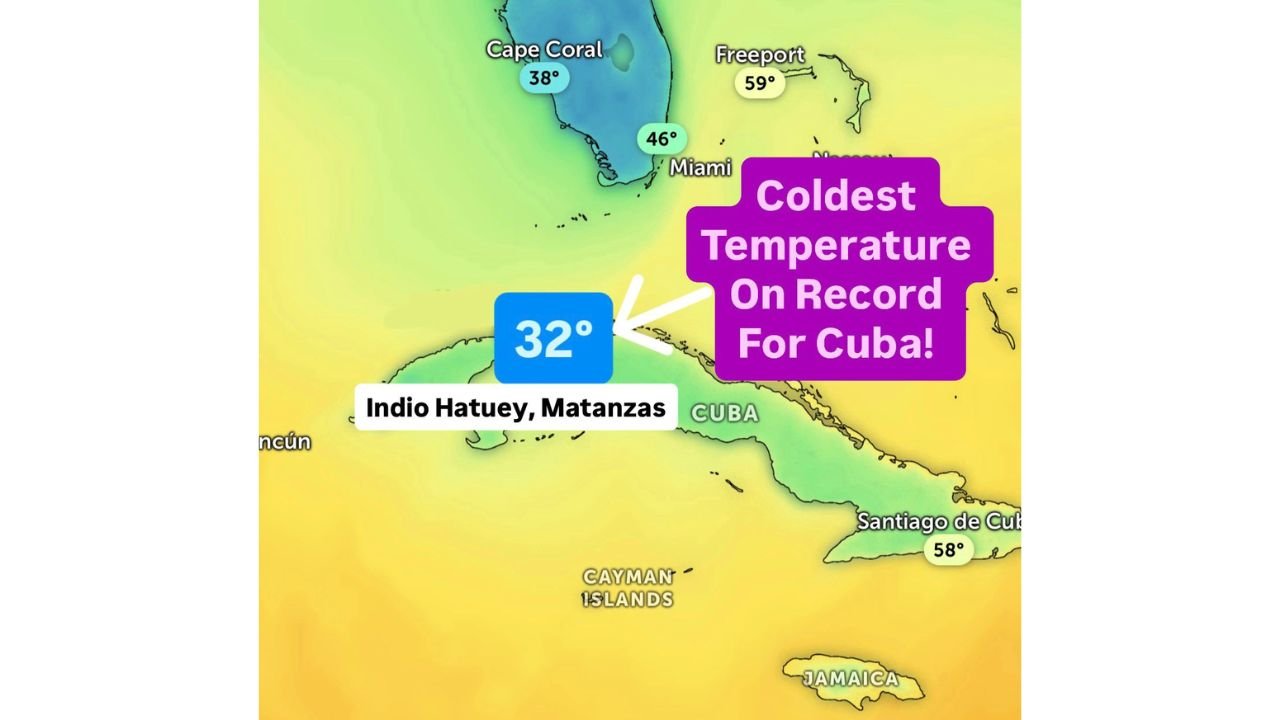
CUBA — A powerful surge of arctic air that first slammed into the U.S. Southeast didn’t stop at Florida, pushing across the Florida Straits and into Cuba, where Indio Hatuey in Matanzas dropped to 32°F—a first-time freezing temperature on record for the country based on the graphic provided.
What the map shows and where the cold hit hardest
The temperature map highlights just how far south the cold air mass was able to travel. In Cuba, the coldest reading shown is 32°F at Indio Hatuey, Matanzas, marked as the coldest temperature on record for Cuba on the graphic.
Nearby readings on the same map show the sharp contrast across the region:
Florida also sat on the edge of the cold pool, with Cape Coral at 38°F and Miami at 46°F. Farther east, the Bahamas appeared much warmer on the map, with Freeport at 59°F, underscoring that this was a focused push of cold air rather than a broad cool-down everywhere.
Why this is a big deal for the Caribbean
A freeze reading in Cuba is rare because ocean water temperatures and tropical latitude usually keep overnight lows above freezing—even when strong cold fronts sweep through. For Matanzas to reach 32°F, the cold air had to be both deep and dense, and the wind pattern had to allow that air to keep moving south over water long enough to reach western Cuba.
The graphic also notes the previous benchmark: the old record was 33°F in 1996, meaning this event didn’t just flirt with an extreme—it set a new threshold for how far this arctic outbreak could push.
What this kind of outbreak can signal for the Southeast
When arctic air can reach South Florida and still surge into Cuba, it’s usually a sign of a strong, well-organized cold pattern across the eastern United States. For places like North Carolina, that matters because these same setups can return in waves—bringing rapid temperature drops, hard freezes, and dangerous wind chills when the next reinforcing shot arrives.
Even if Cabarrus County isn’t dealing with this exact outbreak at the same moment as Cuba, events like this are a reminder to stay alert when the pattern turns active: cold air outbreaks can reload quickly, especially when high pressure remains strong behind repeated fronts. For practical cold-weather preparation tips, the National Weather Service’s guidance on cold safety is a good reference later in the season when another surge is possible.
Key takeaway from this snapshot
Based on the provided map, the headline result is clear: Cuba recorded a freezing 32°F in Matanzas, while South Florida dipped into the 30s and 40s, showing the reach of an unusually strong cold air surge for the region.
If you’re in Cabarrus County and noticed a sharp overnight drop, a burst of wind, or unusually dry, crisp air recently, share what you saw—your local temperature and timing reports help other readers track how these bigger weather patterns show up on the ground. Join the conversation at CabarrusWeekly.com.