Global Ocean Temperatures Surge to Record Territory in Early 2026 as La Niña Fades and El Niño Signals Begin Emerging
UNITED STATES — Preliminary global climate data is showing a dramatic surge in ocean temperatures, with early 2026 sea surface readings climbing well above recent record levels as La Niña fades and signs of El Niño begin to emerge.
Daily Global Sea Surface Temperatures Climb Sharply
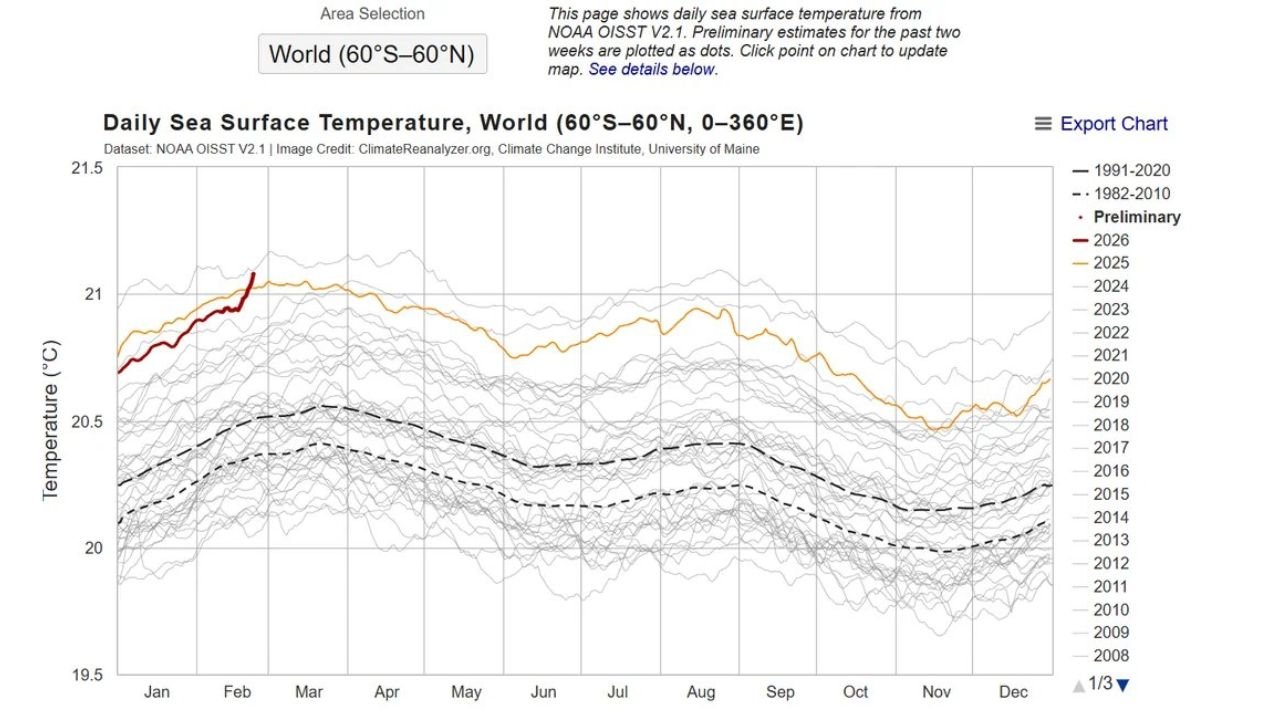
According to global daily sea surface temperature data spanning 60°S to 60°N, early 2026 values are running noticeably higher than previous benchmark years.
The most recent readings show global ocean temperatures rising above 21°C (69.8°F) in February, placing them above the same period in 2023, 2024, and 2025. The preliminary 2026 line is clearly separated from the pack of prior years, reflecting a strong upward spike.
This surge follows a temporary dip associated with La Niña conditions but now appears to be accelerating again.
La Niña Fades as El Niño Signals Strengthen
La Niña typically exerts a modest cooling influence on global ocean surface temperatures, especially across the equatorial Pacific. As those conditions weaken, that suppressive effect diminishes.
The current spike suggests that background warming combined with the early development of El Niño conditions may be amplifying the temperature rise.
El Niño phases often redistribute ocean heat and can contribute to globally elevated average temperatures, especially when layered on top of long-term warming trends.
Well Above Climatological Normals
When compared to historical climatology baselines such as 1991–2020 and 1982–2010 averages, current global sea surface temperatures are running significantly higher.
The gap between the 2026 curve and the long-term average is substantial for this time of year. Even in late winter, when global ocean temperatures are typically lower than late summer peaks, readings are already exceeding previous highs for this calendar date.
This magnitude of departure so early in the year raises concerns that 2026 could rival or exceed recent record-breaking global temperature years if the pattern continues.
Implications for the Rest of the Year
Ocean temperatures play a critical role in regulating global climate patterns. Elevated sea surface temperatures can influence:
Global air temperatures
Tropical cyclone intensity potential
Rainfall distribution patterns
Marine ecosystem stress
If El Niño conditions fully establish during the coming months, additional global warmth could follow, particularly later in the year when ocean-atmosphere coupling strengthens.
While these data remain preliminary, the upward trend is notable enough to warrant close monitoring as the Northern Hemisphere transitions toward spring and summer.
If you’ve noticed unusual warmth or shifting seasonal patterns where you live, share your observations with us. Stay updated on global and regional climate trends at CabarrusWeekly.com.