Louisiana, Mississippi, Alabama, Arkansas, Tennessee, and Georgia Face Major Gulf Moisture Surge by April 4 as Dew Points Climb Into the Mid-60s Ahead of Late-Week Severe Weather Setup
UNITED STATES — A major Gulf of Mexico moisture surge is forecast to push deep into the South and lower Ohio Valley by Saturday, April 4, 2026, setting the stage for what could become a significant severe weather and heavy rain event across a large portion of the central and southeastern United States. Surface dew points across Louisiana, Mississippi, Alabama, Arkansas, Tennessee, and Georgia are forecast to climb into the low to mid 60s°F — a level of atmospheric moisture that provides enormous energy for thunderstorm development and places the region firmly in severe weather territory.
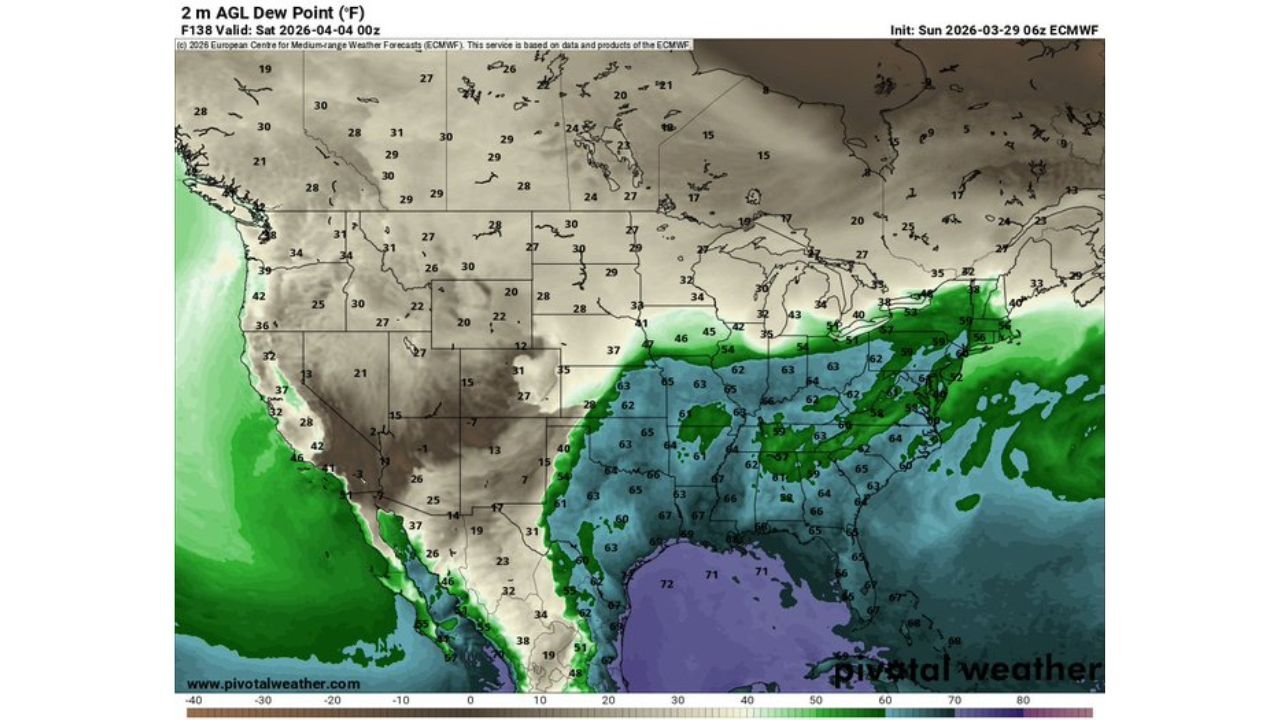
This data is from the ECMWF model initialized March 29, 2026 at 06z, valid Saturday, April 4, 2026.
What a Dew Point Surge Actually Means
Dew point is the single most important number for understanding how dangerous a severe weather setup can become. It measures how much moisture is in the air at the surface — and moisture is the fuel that powers thunderstorms.
When dew points climb into the low 60s°F, the atmosphere has enough moisture to support strong thunderstorm development. When they reach the mid 60s°F, the available energy for storms increases dramatically. Values in the upper 60s°F — which are showing up along the Gulf Coast in this forecast — are the kind of numbers more commonly associated with summer severe weather outbreaks than early April.
The reason this matters so much is simple. More moisture means more fuel. More fuel means storms that develop can become stronger, taller, and more organized. Combined with the strong upper-level trough and closed low forecast for the same period, a dew point surge of this magnitude transforms what might otherwise be an ordinary storm system into a potentially dangerous severe weather event.
Where the Moisture Is Surging
The ECMWF dew point forecast for April 4 shows a sharp and well-defined boundary between dry air across the western United States and rich Gulf moisture pushing northward across the central and southeastern states.
Across the Gulf Coast states, dew points are forecast to reach 65 to 72°F — values that would feel genuinely oppressive for early April and signal an exceptionally deep moisture plume streaming northward from the Gulf of Mexico.
Further inland, the moisture thins but remains substantial. Dew points across Arkansas, Tennessee, and northern Mississippi are forecast in the 60 to 65°F range — still more than sufficient to fuel organized severe thunderstorm development when combined with the strong upper-level dynamics arriving simultaneously.
The Ohio Valley — including Kentucky, southern Indiana, and southern Ohio — is forecast to see dew points climbing into the mid to upper 40s°F, which represents a meaningful increase from typical early April values and will add to the overall instability across the region.
Dew Point Forecast by Region — April 4
| Region | Forecast Dew Point |
|---|---|
| Gulf Coast Louisiana / Mississippi | 67–72°F |
| Southern Alabama / Georgia coast | 65–67°F |
| Central Mississippi / Alabama | 63–66°F |
| Arkansas / Tennessee | 60–65°F |
| Northern Georgia / South Carolina | 60–64°F |
| Kentucky / Southern Indiana | 45–54°F |
| Missouri / Illinois | 40–46°F |
| Kansas / Oklahoma | 35–44°F |
Forecast Confidence Level
High confidence that a significant Gulf moisture surge pushes into the Deep South and lower Mississippi Valley by April 4 — the ECMWF has been consistent across multiple runs on both the timing and magnitude of this moisture plume.
High confidence on dew point values across the Gulf Coast states — the source region moisture is well-established and the transport pattern is clear.
Medium confidence on how far north the richest moisture extends** — the exact position of the moisture boundary across Arkansas, Tennessee, and Kentucky will play a critical role in determining where the most intense storms develop. This detail will sharpen by midweek.
Why Early April Dew Points This High Are Unusual
Dew points in the mid to upper 60s°F are common across the Gulf Coast states during summer — but seeing them this early in April is notable. It signals that the Gulf of Mexico is already running warmer than normal for this time of year, allowing moisture to evaporate more readily from the ocean surface and stream northward with greater intensity.
When an unusually deep Gulf moisture surge arrives ahead of a strong upper-level system this early in the spring season, it creates a mismatch between the cold, energetic air aloft and the warm, humid air at the surface. That temperature and moisture contrast is the engine that drives severe thunderstorm development — and the greater the contrast, the more explosive the potential storm growth.
This is why forecasters are treating the late-week window with particular attention. The ingredients coming together for April 3–4 are not typical for early spring. They are more reminiscent of a mid-May severe weather setup.
What Residents in the Moisture Surge Zone Must Know
The dew point surge is the piece of this puzzle that makes everything else more dangerous. Upper-level troughs arrive regularly — but when they arrive on top of a moisture surge of this magnitude, the severe weather potential increases substantially.
Residents across Louisiana, Mississippi, Alabama, Arkansas, and Tennessee are sitting directly in the path of the richest moisture. When the late-week storm system arrives over this area, it will have the maximum fuel available to work with.
Thunderstorms that develop in environments with dew points in the mid 60s°F can produce extremely large hail, damaging straight-line winds, and tornadoes — particularly when the upper-level wind shear from the approaching trough is added to the equation.
High humidity at the surface also means heavy rainfall rates. When the atmosphere is this loaded with moisture, storms are capable of dropping rainfall at rates of 2 to 4 inches per hour in the heaviest cells — raising the flash flood risk significantly on top of the severe weather threat.
Monitor forecasts daily starting Monday. The exact position of the moisture boundary and the storm track will become much clearer by Tuesday and Wednesday, allowing more specific guidance on which areas face the highest risk.
The Bottom Line
A major Gulf moisture surge is forecast to push into Louisiana, Mississippi, Alabama, Arkansas, Tennessee, and Georgia by April 4, with surface dew points climbing into the low to mid 60s°F — values more typical of a mid-May outbreak than early April. This exceptionally deep moisture plume arriving simultaneously with a strong upper-level trough and closed low creates one of the more concerning atmospheric setups seen so far this spring across the Deep South and Ohio Valley. The moisture is the fuel. The upper-level system is the trigger. When both arrive together, significant severe weather becomes a real possibility. Stay informed and stay ready as the week develops.
Stay ahead of dangerous weather before it reaches your door. Visit cabarrusweekly.com for daily severe weather coverage, moisture surge alerts, and forecast updates from across the United States — because knowing early is the difference that matters.