Midwest Ag Belt Could See Late-February Warm Surge Followed by Early-March Cold Reversal, Pattern Echoes 2023 Temperature Swing
UNITED STATES — Long-range guidance suggests the Midwest agricultural belt could experience a notable warmup in late February into early March, followed by a colder reversal as planting season approaches.
The evolving pattern bears similarities to temperature trends observed during March 2023, when early warmth gave way to a sharp cool-down later in the month.
Late February to Early March: Warmth Expands Across the Ag Belt
Current outlook discussions highlight the potential for above-normal temperatures across the central United States, particularly through the Corn Belt and broader Midwest region.
States such as Iowa, Illinois, Indiana, Missouri, Nebraska, and Kansas could see temperatures climb well above seasonal averages during the late-February to early-March window.
This type of warm surge often promotes early soil thawing and can temporarily accelerate field readiness, especially across lower elevations of the central Plains and Mid-Mississippi Valley.
2023 as a Pattern Comparison
Temperature anomaly maps from March 1–14, 2023, show a generally mild start to the month across much of the eastern and southern United States, with parts of the Midwest running slightly above average.
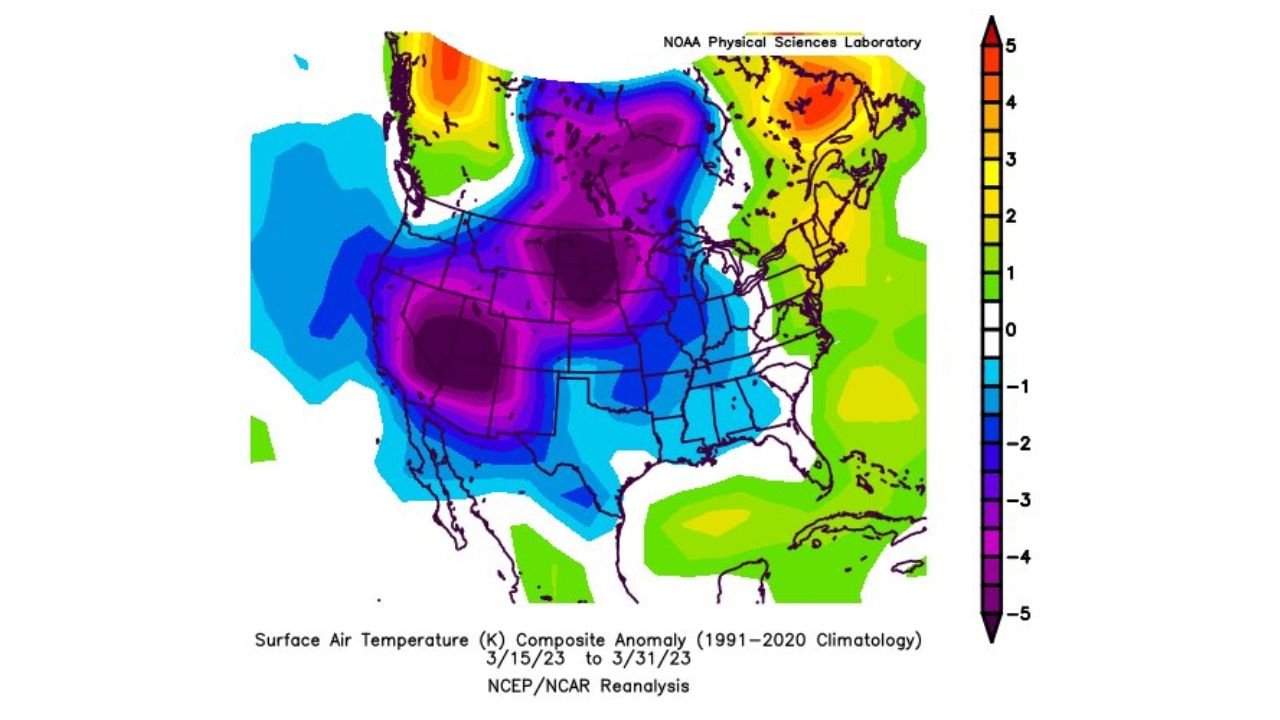
However, during the March 15–31, 2023 period, a colder pattern expanded across the central U.S., with widespread below-normal readings stretching from the Rockies through the Plains and into portions of the Midwest.
This historical analog suggests that even after a warm early-month stretch, a return to cooler conditions remains possible deeper into March.
Early March Warmth Could Reverse as Planting Nears
The long-range signal indicates the potential for temperatures to trend back below normal later in March, particularly across the central Plains and portions of the Upper Midwest.
A reversal of this kind can introduce challenges for early-season agricultural planning, especially if soil temperatures drop after initial warming.
While not every year follows a strict analog, the pattern comparison to 2023 raises the possibility of:
• A mild late-February and early-March stretch
• Followed by a cooler mid-to-late March period
Such swings are not uncommon during seasonal transitions, when upper-level pattern shifts can quickly redirect air masses across the continent.
Regional Breakdown
The strongest late-February warmth signal appears focused on the central Ag Belt, including parts of the Midwest and Plains.
If the colder phase materializes later in March, below-normal temperatures could spread from the Rockies eastward into the Plains and possibly into portions of the western Midwest.
The eastern U.S., including the Southeast and Mid-Atlantic, may remain comparatively milder depending on how far south the colder air penetrates.
Bottom Line
The developing long-range outlook suggests a potentially significant temperature swing for the Midwest agricultural belt — warming notably in late February and early March, then possibly turning colder later in March as planting preparations begin.
While long-range forecasts always carry uncertainty, the comparison to March 2023 provides a meaningful reference point for how such a pattern could evolve.
If you are noticing early signs of warming or preparing fields for planting across the Midwest, share your observations and local conditions with us at CabarrusWeekly.com.