NOAA Signals La Niña Ending Soon, ENSO-Neutral by Late Spring and El Niño Likely to Develop by Summer 2026
UNITED STATES — The latest outlook from NOAA’s Climate Prediction Center indicates a major shift underway in the Pacific Ocean, with La Niña expected to fade in the coming weeks, ENSO-neutral conditions favored this spring, and El Niño increasingly likely to develop by summer 2026.
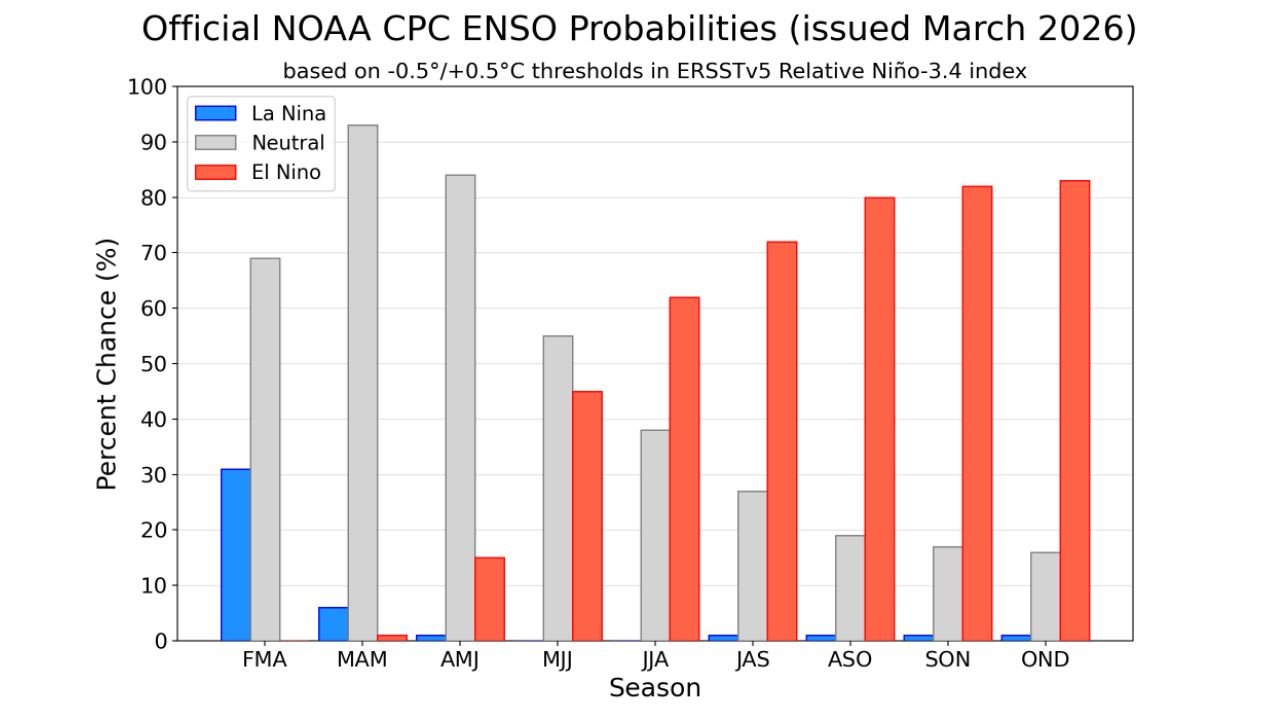
Newly issued probability guidance for March 2026 shows a clear transition unfolding over the next several months.
La Niña Weakening This Spring
Current projections suggest La Niña conditions will diminish within the next month.
For the late winter period (FMA), La Niña still holds roughly a 30% chance. However, those odds drop sharply by spring:
- MAM (March–April–May): La Niña near 5–10%
- AMJ (April–May–June): Near 0–5%
By late spring, La Niña is no longer the dominant climate signal.
ENSO-Neutral Favored Through Late Spring
As La Niña fades, ENSO-neutral conditions are forecast to take hold.
- MAM 2026: Neutral probability peaks around 55%
- AMJ 2026: Neutral remains dominant
- MJJ 2026: Neutral around 55%
This means ocean temperatures in the Niño 3.4 region are expected to hover near average through much of late spring and early summer.
Neutral phases often produce more variable and less predictable seasonal weather patterns across the United States.
El Niño Odds Surge by Summer
The most striking signal in the outlook is the rapid increase in El Niño probabilities beginning in early summer.
- JJA (June–July–August): El Niño around 60%+
- JAS (July–August–September): Near 70%
- ASO (August–September–October): Around 80%
- SON and OND 2026: Exceeding 80%
By late summer and fall 2026, El Niño becomes the overwhelmingly favored phase, with probabilities above 80% and very little chance of a return to La Niña.
What This Means for the U.S.
While Cabarrus County and the Southeast are not directly mentioned in the probability chart, ENSO shifts often influence large-scale weather patterns nationwide.
Historically:
- La Niña winters can favor active severe weather seasons in the South and Southeast.
- El Niño winters often shift storm tracks and can enhance southern U.S. precipitation while reducing Atlantic hurricane activity.
However, summer impacts are more nuanced and can vary depending on the strength and structure of the developing El Niño.
The Big Picture
The current forecast outlines a three-step evolution:
- La Niña fading in early spring
- ENSO-neutral through late spring
- El Niño developing by summer and persisting through at least the end of 2026
This type of full-phase transition within a single year is significant and will be closely monitored by climatologists in the months ahead.
Bottom Line
NOAA’s latest outlook points to the end of La Niña within weeks, a neutral Pacific by late spring, and a strong likelihood that El Niño takes control by summer 2026 — with odds exceeding 80% by fall.
CabarrusWeekly.com will continue tracking updates to ENSO projections and what they may mean for seasonal weather patterns across North Carolina and the broader United States.