Rare ‘Selenelion’ Lunar Eclipse to Turn Moon Deep Red Across the U.S., With East Coast Set for Stunning Sunrise Alignment
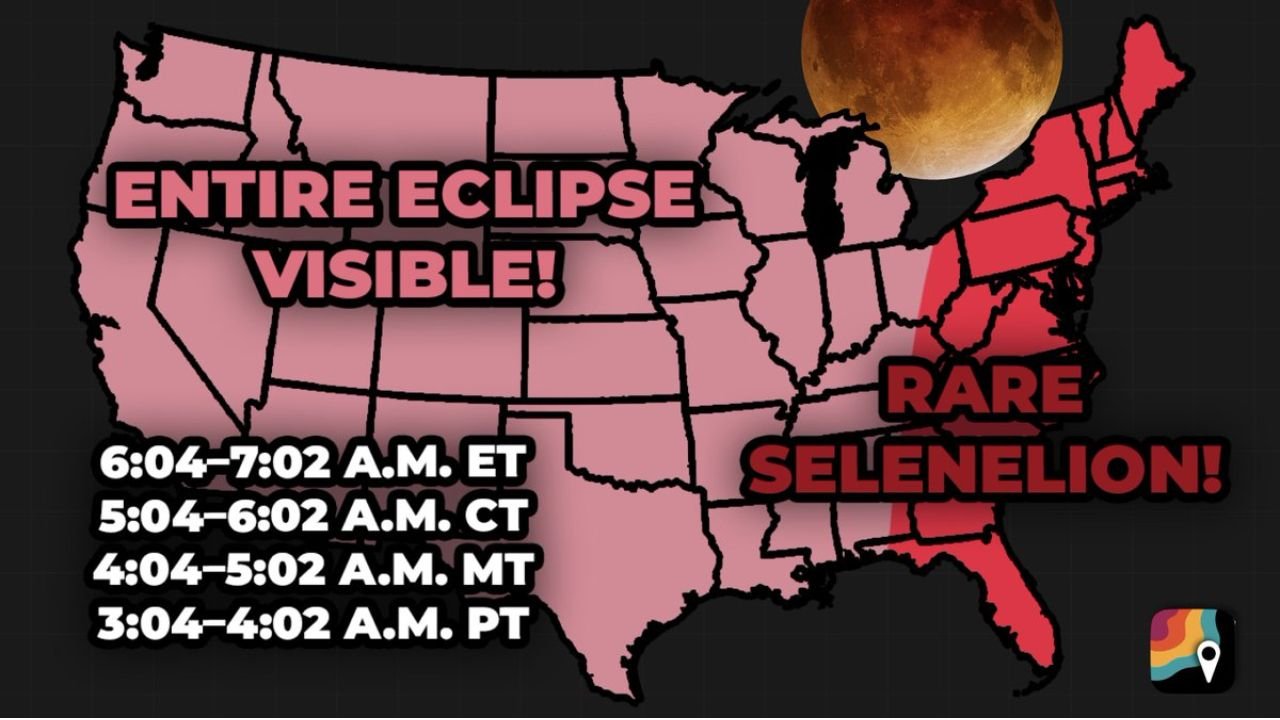
UNITED STATES — Skywatchers across the country are preparing for a striking celestial event as the moon is set to turn a deep, rusty red during a total lunar eclipse lasting 58 minutes. While the entire United States will be able to see the full eclipse, viewers along the East Coast could witness an especially rare phenomenon known as a “selenelion,” when the eclipsed moon sets at the same time the sun rises.
According to the timing provided, totality — when the moon is fully within Earth’s shadow — will span just under an hour, offering a wide window for early risers to step outside and watch the transformation unfold.
Entire Eclipse Visible Nationwide
The graphic indicates that the entire eclipse will be visible across all 50 states, with the following time windows by time zone:
- 6:04–7:02 A.M. Eastern Time
- 5:04–6:02 A.M. Central Time
- 4:04–5:02 A.M. Mountain Time
- 3:04–4:02 A.M. Pacific Time
During this period, the moon will gradually shift from its usual bright glow to a brownish-red hue as it slips into Earth’s shadow. The reddish color occurs because sunlight bends through Earth’s atmosphere and filters onto the lunar surface — similar to how sunsets appear red or orange.
Because the eclipse happens during the early morning hours, viewers are encouraged to find a location with a clear view of the western horizon, where the moon will be descending.
East Coast to Experience Rare ‘Selenelion’
The most dramatic viewing opportunity will be along the East Coast, where the eclipse coincides with local sunrise and moonset.
This creates a rare alignment known as a selenelion, where the rising sun and the eclipsed moon are visible at the same time — positioned on opposite horizons. For a brief window of just a few minutes, observers could see:
- The rising sun in the eastern sky
- The deep red eclipsed moon setting in the west
This effect happens because Earth’s atmosphere bends, or refracts, light. That bending can allow the moon to remain visible even when it is technically below the geometric horizon. Under the right temperature and atmospheric conditions, this “impossible” view may last slightly longer.
Clear sightlines to both horizons — and higher elevation if possible — will significantly improve viewing chances.
What Makes This Eclipse Special?
While total lunar eclipses are not extremely rare, a sunrise selenelion visible across the East Coast is far less common. The overlapping timing between totality and local sunrise creates a brief but dramatic planetary alignment that many skywatchers may never see in their lifetime.
The combination of a fully red moon, simultaneous sunrise, and the entire country being able to view totality makes this event especially memorable.
Viewing Tips for Waldron and Surrounding Areas
For residents in Waldron and surrounding communities, the eclipse will occur in the early morning hours before sunrise. To maximize visibility:
- Head outdoors at least 10–15 minutes before your listed time window.
- Choose an open area away from trees and buildings.
- Look toward the western horizon as totality progresses.
- If you’re on the East Coast, position yourself where both eastern and western horizons are visible for the selenelion effect.
No special equipment is needed — the eclipse is safe to view with the naked eye.
Don’t Miss This 58-Minute Window
With just under an hour of totality and a potentially magical sunrise pairing along the East Coast, this lunar eclipse promises to be one of the most photogenic sky events of the year.
Have plans to watch it? Share your photos and let us know what you see.
Stay connected with Cabarrusweekly.com for more local updates, weather alerts, and skywatching events affecting our community.