Southeast Drought Deepens as La Niña’s Grip Lingers Across Florida and the Carolinas Despite Growing El Niño Signals for Late 2026
SOUTHEASTERN UNITED STATES — Dry conditions remain firmly in place across Florida, Georgia, the Carolinas, and parts of the broader Southeast as lingering La Niña influences continue to dominate the regional weather pattern, keeping rainfall limited and drought concerns elevated heading toward late winter and early spring.
Lingering La Niña Continues to Suppress Rainfall Across the Southeast
Despite increasing attention on the potential development of El Niño later in 2026, current atmospheric and oceanic patterns show La Niña’s influence is still very much active across the Southeast. Forecast precipitation anomaly data for mid-to-late February highlights widespread below-average rainfall stretching from Florida through Georgia, South Carolina, North Carolina, Alabama, and parts of Tennessee. This dry signal aligns with a persistent subtropical ridge that continues to steer storm systems north and west of the region.
In Florida, rainfall deficits remain particularly pronounced, reinforcing an already dry winter season. Much of the Carolinas and coastal Georgia are also seeing continued moisture shortages, with little indication of sustained rainfall relief in the near term.
Drought Conditions Expand and Intensify From Florida to the Carolinas
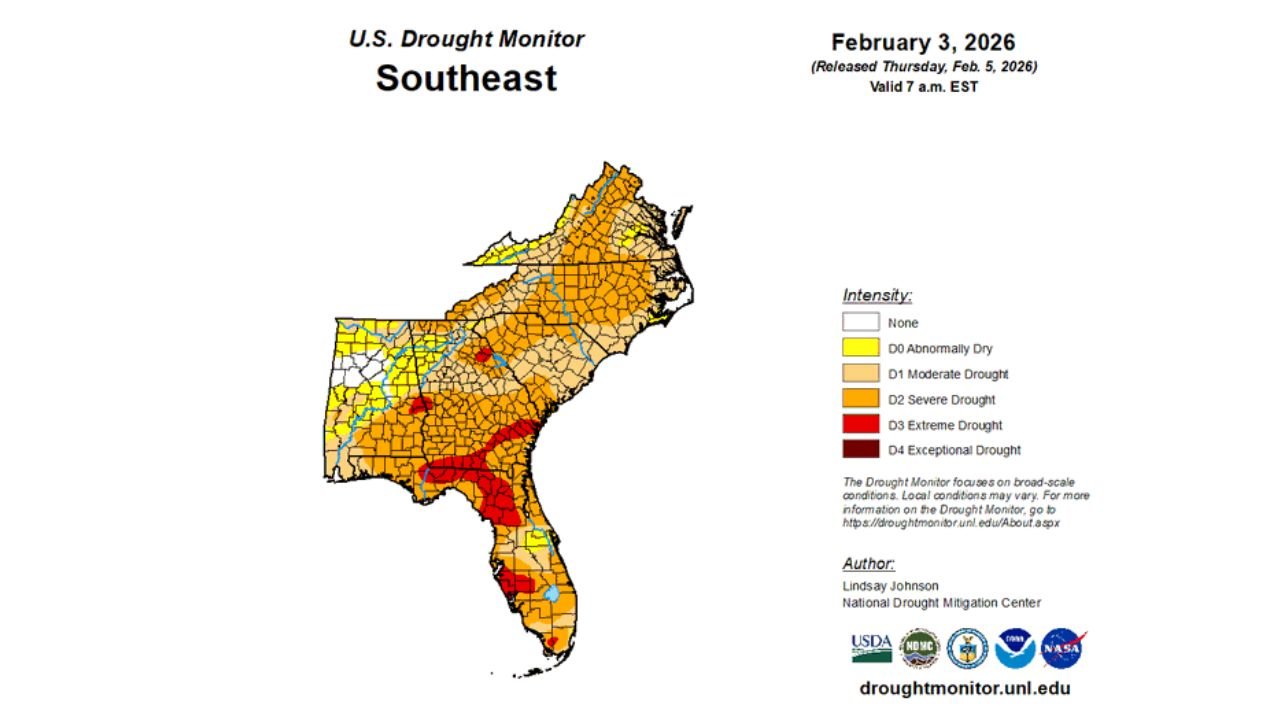
The latest U.S. Drought Monitor update shows moderate to severe drought expanding across large portions of the Southeast, with pockets of extreme drought now firmly established in central and southern Florida. Drought classifications have also intensified across southern Georgia, parts of South Carolina, and southeastern North Carolina, reflecting months of suppressed rainfall and ongoing soil moisture loss.
These conditions are consistent with forecast guidance that shows no meaningful precipitation recovery through at least late February, raising concerns about groundwater levels, agriculture stress, and early-season wildfire potential.
Fire Weather and Environmental Risks Remain Elevated
With dry fuels, low humidity, and limited rainfall, fire danger remains an increasing concern across Florida and the Southeast. While winter temperatures have kept extreme fire behavior somewhat in check, the lack of moisture is allowing vegetation to dry out faster than normal. Forestry officials across the region are closely monitoring conditions, especially in areas where drought intensity is classified as severe or extreme.
As spring approaches, the combination of dry ground, increasing temperatures, and gusty winds could further elevate fire risk if meaningful rainfall does not materialize soon.
Pacific MJO and ENSO Transition Could Bring Limited Relief in March
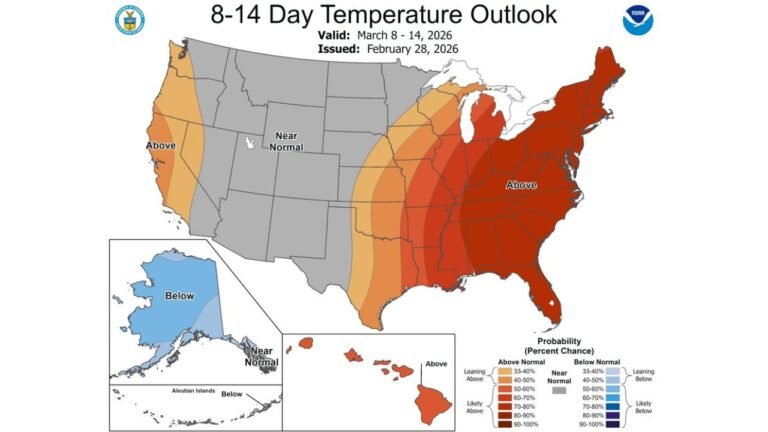
Looking ahead, there is some potential for modest rainfall improvement in March, tied to a possible Pacific Madden–Julian Oscillation (MJO) event and the gradual weakening of La Niña. Ensemble guidance suggests parts of the Southeast may see slightly above-normal precipitation later in March if the MJO phase aligns favorably and +ENSO conditions continue to strengthen.
However, meteorologists caution that any improvement is likely to be uneven and temporary, and not sufficient to fully erase existing drought conditions. El Niño’s influence is not expected to become a dominant factor until later in 2026, meaning the Southeast remains vulnerable to extended dry spells in the meantime.
Outlook: Dry Pattern Likely to Persist Into Early Spring
Overall, forecast confidence remains high that dry weather will continue to dominate the Southeast over the next several weeks. While isolated rain events may occur, the broader pattern favors continued moisture deficits across Florida, the Carolinas, and neighboring states. Until larger-scale atmospheric shifts take hold, drought and fire concerns will remain a key issue for the region.
Residents, farmers, and land managers are encouraged to remain mindful of water usage and fire safety as the Southeast navigates this prolonged dry stretch.
If you’re experiencing unusually dry conditions, water restrictions, or fire concerns in your area, share what you’re seeing with us. Your local reports help us track how these patterns are impacting communities across the region. Join the conversation at CabarrusWeekly.com.