Texas, Florida and the Southeast Shatter March Warm-Night Records as ‘Historic Summer Night’ Sends Lows Into the 70s
UNITED STATES — What is typically one of the cooler stretches of early spring instead felt more like midsummer overnight across large portions of the South and East.
A wave of exceptionally warm air led to what forecasters are calling a “historic summer night,” with hundreds of record warm minimum temperatures either broken or threatened across multiple states.
Unbelievable Overnight Lows Across the South
Instead of cooling into the 40s or 50s — typical for early March — many states barely dipped out of the 60s and 70s overnight.
Reported warm minimum temperatures included:
- 76°F in Texas and Florida
- 75°F in Louisiana
- 73°F in Mississippi and Arkansas
- 71°F in Tennessee
- 68°F in Alabama, Georgia and South Carolina
- 66°F in West Virginia and Ohio
- 65°F in North Carolina
- 64°F in Pennsylvania
- 63°F in Indiana
- 61°F in Virginia and Illinois
- 60°F in Michigan
These numbers represent nighttime lows — not afternoon highs — underscoring just how unusual the air mass is for early March.
Hundreds of March Records at Risk
Many climate sites track both daytime high records and warmest overnight low records. In this case, it’s the high minimum category that is being challenged.
Warm overnight temperatures can be especially significant because:
- They prevent cooling and recovery from daytime heat.
- They indicate strong moisture and sustained warm air advection.
- They often signal an anomalously strong upper-level ridge pattern.
Across much of the Southeast, existing record warm minimums were either broken outright or remain in jeopardy through midnight.
A Massive Warm Anomaly
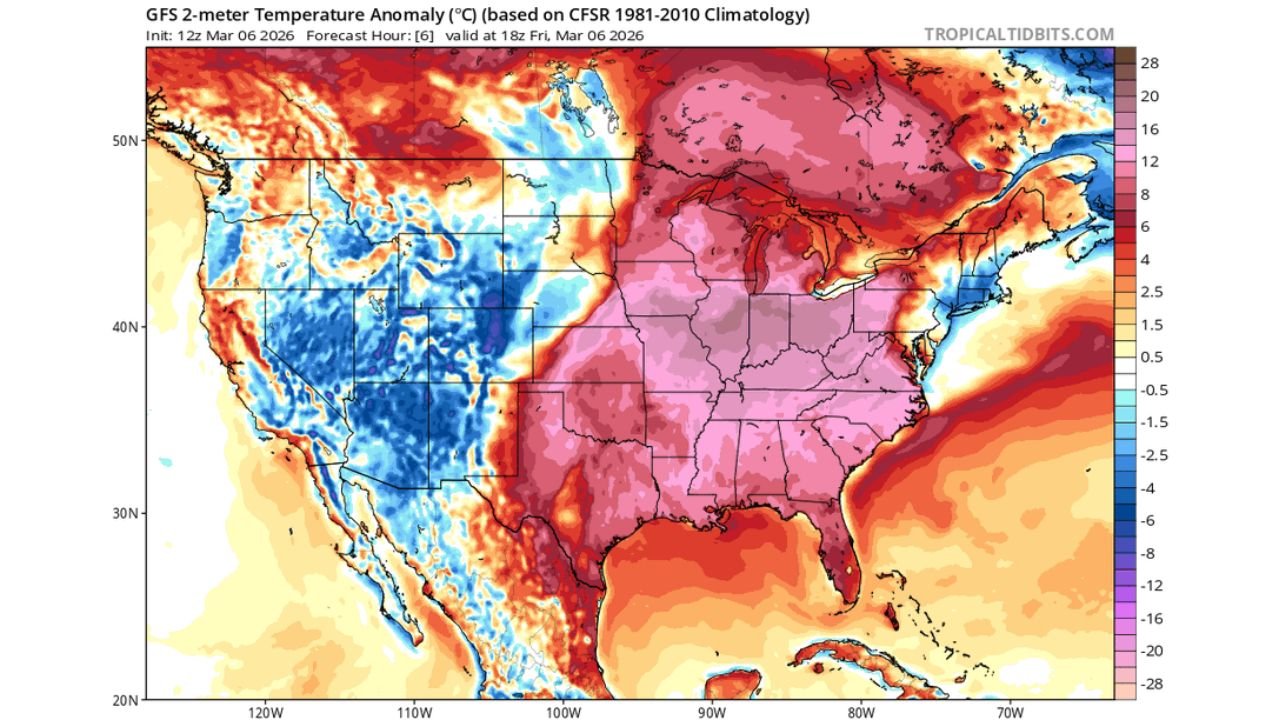
Temperature anomaly maps show much of the eastern half of the United States running well above seasonal averages.
The most pronounced warmth stretches from:
- Texas
- Louisiana
- Mississippi
- Alabama
- Georgia
- Florida
- Tennessee
- The Carolinas
- Into parts of the Midwest and Great Lakes
The deep red and pink anomaly shading across these regions reflects temperatures running dramatically above the 1981–2010 climatological baseline for early March.
Meanwhile, cooler-than-average air remains locked across much of the western United States, creating a sharp east-west temperature contrast nationwide.
Why the Nights Stayed So Warm
Several factors contributed to the exceptional overnight warmth:
- Persistent southerly flow pulling Gulf moisture northward.
- Elevated humidity levels limiting radiational cooling.
- A strong upper ridge trapping warm air across the region.
- Cloud cover in some areas preventing heat loss.
When moisture and warm air combine overnight, temperatures often struggle to drop — but lows in the mid-70s during early March are highly unusual.
Southeast Most Impacted
While parts of the Midwest and Mid-Atlantic also experienced very mild nights, the Southeast stands out as the region most likely to officially lock in record warm minimum temperatures before midnight.
States such as Texas, Florida, Louisiana, Mississippi, Alabama and Georgia were at the center of the most extreme overnight warmth.
Bottom Line
A historic warm surge produced summerlike overnight lows across much of the South and East, with temperatures staying in the 70s in Texas and Florida and well into the 60s as far north as the Midwest and Ohio Valley.
Hundreds of March warm-night records are being challenged, highlighting just how anomalous this early-season heat event is.
CabarrusWeekly.com will continue tracking how long this unusual warmth persists and when cooler air may finally return.