Winter Storm Fern Leaves Northern Mississippi With Weeks-Long Power Outages as Ice Damage Tops 1 Inch in Hardest-Hit Counties
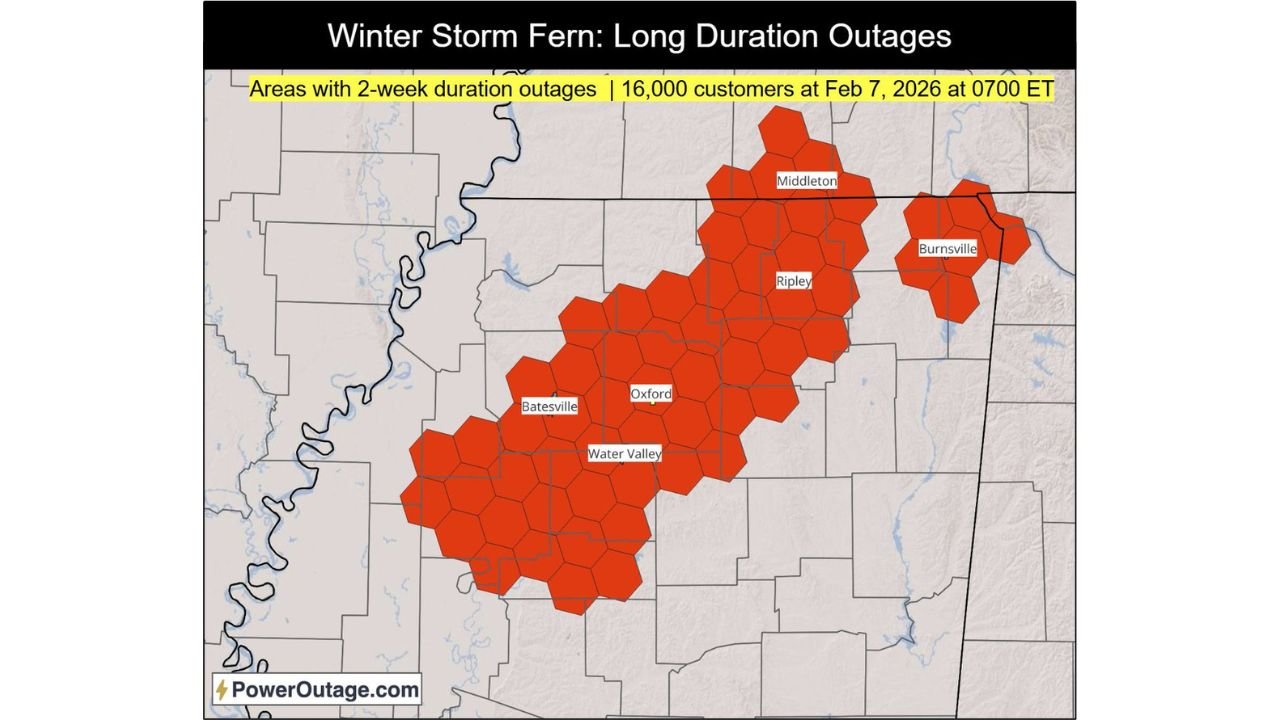
NORTHERN MISSISSIPPI — More than two weeks after Winter Storm Fern delivered a historic ice storm across the region, thousands of residents in northern Mississippi are still without electricity, highlighting how long recovery can take when ice loads reach the destructive range. Data shown on a long-duration outage map indicates about 16,000 customers were still without power as of 7:00 a.m. ET on Feb. 7, 2026, with the highest concentration of persistent outages clustered across a broad corridor of communities.
What the outage map shows right now
The long-duration outage zone stretches across multiple parts of northern Mississippi, with notable concentrations around Batesville, Oxford, Water Valley, Ripley, Middleton, and Burnsville. The map specifically flags these areas as locations where outages have persisted for roughly two weeks, signaling that the damage is not limited to scattered line issues, but instead reflects widespread impacts to the electric distribution system.
In storms like this, the pattern of outages often mirrors where the heaviest ice accretion occurred, where trees were most vulnerable to snapping, and where power poles and crossarms experienced the greatest stress.
Why recovery is taking so long after this ice storm
The storm’s biggest warning sign is the reported ice accretion exceeding 1 inch in the hardest-hit area. Once ice reaches that level, it stops being a simple “slick roads” event and becomes an infrastructure crisis.
Here’s why it can take weeks instead of days:
- Broken poles and structural failures: Heavy ice doesn’t just knock lines down. It can snap poles, bend hardware, and collapse spans, requiring full replacement work.
- Tree damage is not a quick cleanup: Ice-laden limbs can fall long after the storm ends, especially when temperatures fluctuate and winds pick up.
- Rebuild work is slower than repair work: When utilities have to rebuild sections of the grid—rather than re-energize intact lines—restoration becomes a construction project, not a troubleshooting job.
- Access problems in rural zones: Remote lines, muddy terrain, and debris fields add hours to every repair and can force crews to prioritize critical feeders first.
This is why some households can be restored quickly while nearby neighborhoods remain dark for days longer—because they may be on a different circuit or awaiting pole and transformer replacements.
What residents in the hardest-hit communities should do next
For families still dealing with long-duration outages in the Batesville–Oxford–Water Valley corridor and the Ripley–Middleton–Burnsville area, the biggest risks now are secondary: cold exposure, generator hazards, food safety, and carbon monoxide poisoning.
Key safety reminders during prolonged outages include:
- Never run generators indoors, in garages, or near open windows
- Use flashlights instead of candles to reduce fire risk
- Keep refrigerated food safety in mind and discard items that warmed too long
- Check on neighbors who are elderly, disabled, or medically dependent on powered devices
- Charge phones in the car only with good ventilation and never in an enclosed space
What this means for the rest of the Southeast
Even for readers outside Mississippi, this outage situation is an important reminder of how quickly ice storms can escalate in the South. Unlike snow-prone regions that may be built to handle frequent winter weather, severe ice events in the Southeast can be especially damaging because trees, infrastructure, and communities are not always designed for repeated heavy icing.
When ice accretion pushes past the 1-inch mark, the storm’s impact can shift from “days of inconvenience” to “weeks of recovery,” including ongoing repairs that stretch well beyond the initial weather headlines.
If you have friends or family in northern Mississippi, now is a good time to check in—especially in the areas around Batesville, Oxford, Water Valley, Ripley, Middleton, and Burnsville, where the highest concentration of prolonged outages has been highlighted.
Want Cabarrus Weekly to keep tracking major winter hazards across the region this season? Share where your family is located and whether you’ve dealt with extended outages before—join the conversation at CabarrusWeekly.com.