Winter 2025–2026 Becomes Warmest on Record in the Western U.S., Marking a Historic 4-Sigma Climate Event
UNITED STATES — Winter 2025–2026 is now officially the warmest winter on record for the Western United States, according to newly released NOAA data, marking what scientists describe as a 4-sigma climate event compared to the 1901–1930 baseline.
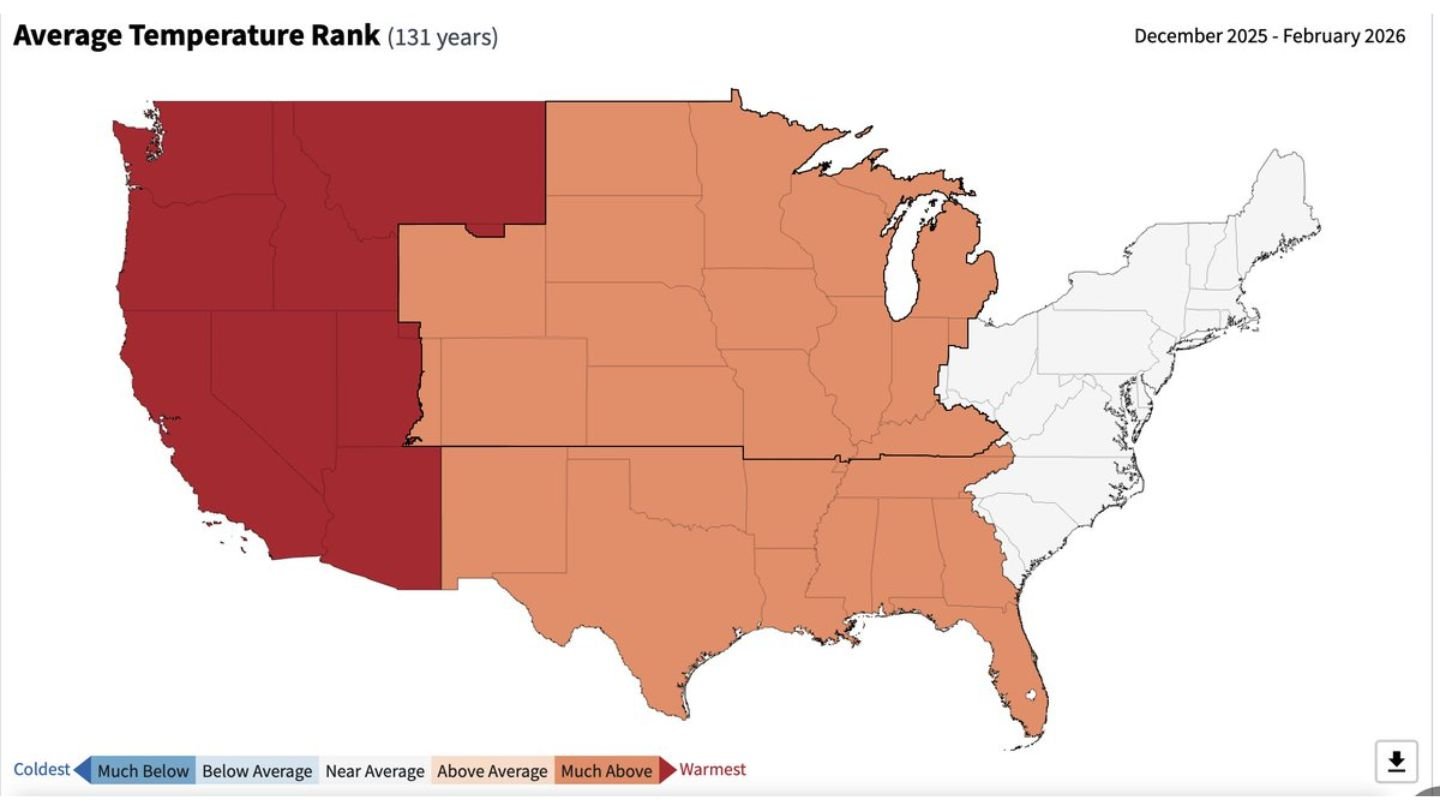
The December 2025 through February 2026 temperature rankings show the western states — including California, Oregon, Washington, Nevada, Idaho, Utah and Arizona — registering their warmest winter in the 131-year historical record.
Western States See Record Warmth
The temperature rank map indicates:
- The West Coast and much of the interior West experienced their warmest winter on record.
- States such as California, Oregon and Washington were firmly in the “warmest” category.
- Neighboring states across the Great Basin and Southwest also ranked at or near record warmth.
This marks the highest winter average temperature ranking for the region since modern recordkeeping began in the late 19th century.
Above Average Across Much of the Central U.S.
While the Western U.S. stood out for record-breaking warmth, much of the central and southern United States also experienced above-average to much-above-average temperatures.
States across the Plains, Midwest and Southeast were largely shaded in above-average categories, underscoring the widespread nature of the warmth.
In contrast, portions of the Northeast were closer to near-average conditions relative to long-term records.
A 4-Sigma Event
Compared to the 1901–1930 climate baseline, NOAA indicates this winter qualifies as a 4-sigma event — meaning it deviated four standard deviations from the historical average.
In statistical terms, an event of that magnitude would have been extraordinarily unlikely under early 20th-century climate conditions.
Climatologists note that winters of this warmth would have been virtually impossible without the background influence of long-term climate warming.
What This Means
A record-warm winter across the Western U.S. carries multiple implications:
- Reduced mountain snowpack in some regions
- Earlier seasonal snowmelt
- Elevated drought risk heading into spring
- Increased wildfire vulnerability later in the year
While local impacts vary from state to state, the regional temperature anomaly is historically significant.
Historic Context
The temperature ranking spans 131 years of data, making Winter 2025–2026 the top-ranked warmest winter in the Western U.S. since at least the late 1800s.
With much of the West colored in the highest temperature category, the data underscores how exceptional this season was compared to the long-term record.
Bottom Line
Winter 2025–2026 now stands as the warmest winter ever recorded in the Western United States, a 4-sigma event relative to early 20th-century climate conditions. The scale and intensity of the warmth make this season historically unprecedented in the modern record.
CabarrusWeekly.com will continue tracking major climate and weather developments as new data becomes available.