Southwest, California and Arizona Record Warmest Year to Date Temperatures Since 1895 While Sitting Among the 25 Driest on Record
UNITED STATES — The combination of record-breaking heat and critically low precipitation across the Southwest through the first four months of 2026 is creating a dangerous situation for water resources and regional reservoirs. January through April 2026 rankings show temperatures across almost the entire Southwest sitting at the warmest on record since 1895, while precipitation ranks among the 25 driest on record over the same 132-year period.
The Temperature Picture — Warmest on Record Across the West
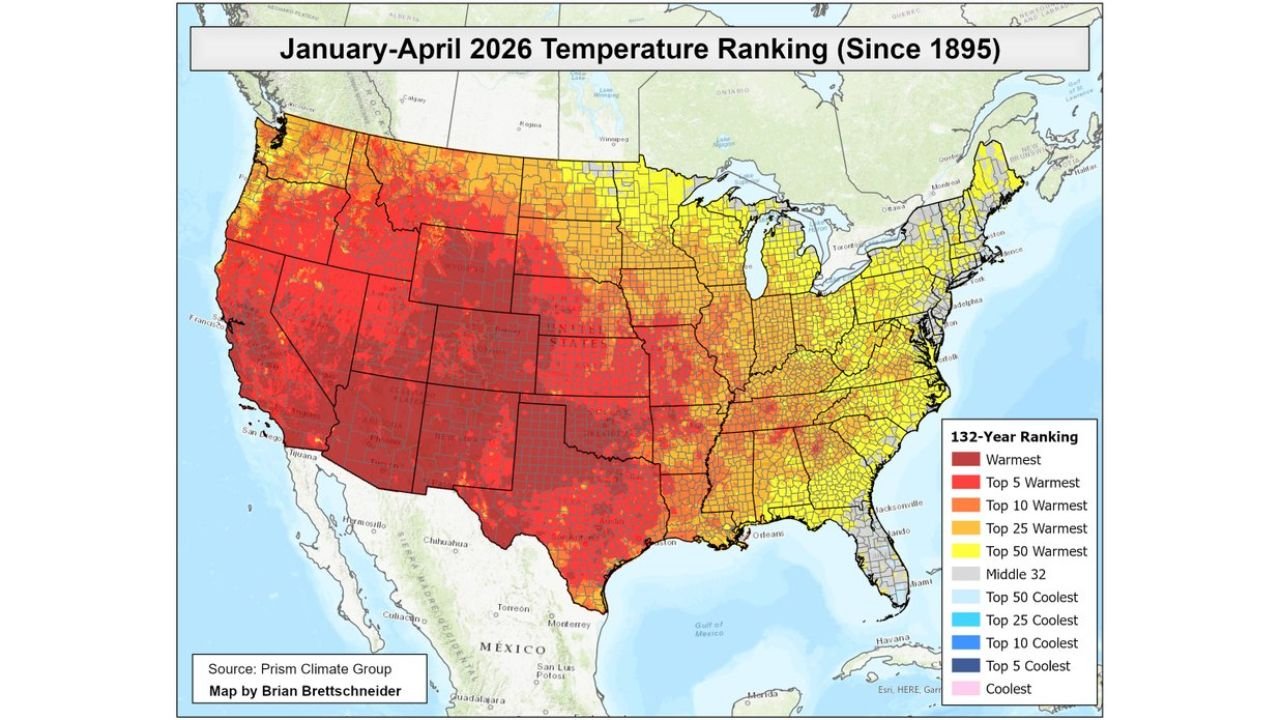
The January through April 2026 Temperature Ranking map shows a striking wall of deep red and dark maroon — the warmest and top 5 warmest categories — blanketing virtually the entire western half of the United States. The most extreme warmth rankings cover:
Warmest on record designations dominate across California, Arizona, Nevada, Utah, New Mexico, Colorado, Wyoming, Montana, Idaho, Oregon, Washington, Texas, Oklahoma, Kansas, and Nebraska. The deep maroon shading indicating the single warmest year in the 132-year record stretches almost unbroken from the Pacific Coast eastward through the central Plains.
The eastern United States tells a more moderate story, with temperature rankings shifting to top 25 warmest across much of the Ohio Valley, Mid-Atlantic, and Southeast, and near middle-of-the-record readings across parts of New England and the Northeast.
The Precipitation Picture — Among the Driest on Record in the West
The January through April 2026 Precipitation Ranking map shows the West running critically dry. The Southwest, California, Arizona, Nevada, and much of the Intermountain West sit in the top 25 driest to top 5 driest categories out of 132 years, with scattered pockets of the absolute driest on record appearing across portions of the Southwest, southern Plains, and the Southeast.
In sharp contrast, the Great Lakes region stands out as a zone of significant wetness, with Michigan and surrounding areas ranking among the top 5 wettest and even the single wettest on record for January through April. The Ohio Valley and parts of the central Midwest also rank in the top 10 to top 25 wettest categories.
The Southeast from the Carolinas through Georgia and Florida is running among the top 10 driest — a deeply concerning signal that compounds the drought conditions already established across those states.
Why This Combination Is So Dangerous for the Southwest
The pairing of record warmth and extreme dryness creates compounding stress on water systems. Higher temperatures increase evaporation from soils, lakes, and reservoirs at the same time that precipitation deficits are preventing those water bodies from being replenished. The result is a severe strain on water resources across Arizona, California, Nevada, Utah, and the broader Southwest heading into the warm season when water demand peaks and natural precipitation is at its lowest.
Stay with CabarrusWeekly.com for continuing coverage of drought and water resource conditions across the Southwest and the rest of the country.