Rockies, Plains and Midwest See Record-Breaking Early Spring Leaf-Out as Millions Experience Unusual Seasonal Shift
UNITED STATES — An unusually early arrival of spring is being observed across large parts of the country, where millions of Americans are experiencing plant growth weeks ahead of normal seasonal timing.
Widespread Early Leaf-Out Across Rockies and Plains
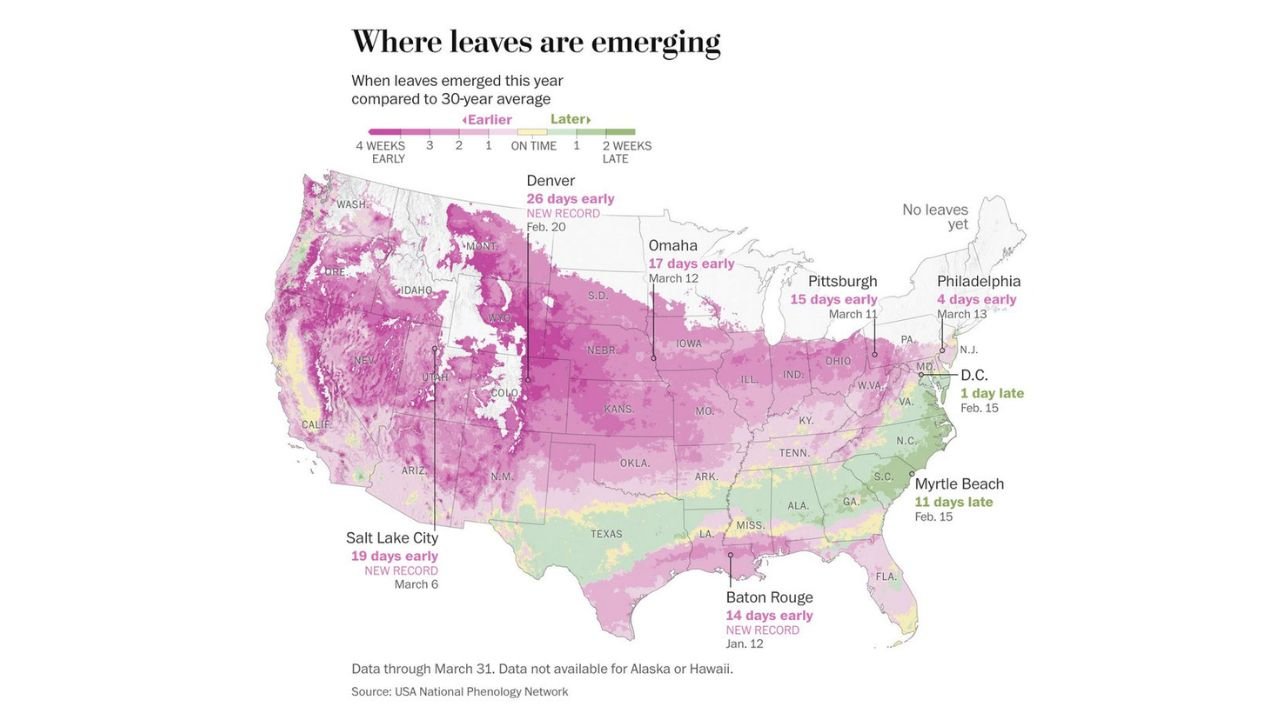
A significant portion of the United States, particularly across the Rockies and the Plains, is seeing leaves emerge 30 to 50 days earlier than average, marking one of the most accelerated spring onsets in recent years.
This early growth has been identified through plant indicators such as lilac and honeysuckle, which are commonly used to track seasonal changes. The widespread nature of this shift highlights how spring conditions have advanced well ahead of typical timelines.
Nearly 190 Million Americans Affected by Early Spring Shift
Approximately 190 million Americans are experiencing this earlier-than-normal spring leaf-out, indicating that this is not a localized phenomenon but a broad, nationwide pattern.
From the central U.S. stretching into parts of the Midwest, vegetation is responding quickly to changing conditions, leading to earlier blooming, leaf development, and seasonal transitions.
Record-Breaking Early Emergence in Multiple Cities
Several cities are already reporting record early leaf-out dates. Denver has seen leaves emerge 26 days earlier than average, while Salt Lake City recorded a 19-day early emergence, setting new benchmarks.
In the central Plains, Omaha is experiencing leaf-out about 17 days early, while regions further east such as Pittsburgh and Philadelphia are also seeing earlier-than-normal development, though less extreme compared to western areas.
Southern and Eastern Regions Show Mixed Timing
While much of the country is ahead of schedule, parts of the Southeast show a more varied pattern. Some areas are near normal timing, while others, such as coastal regions, are experiencing slightly delayed or near-average leaf emergence.
This contrast highlights how regional weather differences are influencing plant behavior differently across the country.
What’s Driving This Early Seasonal Change
The early arrival of spring is largely linked to warmer-than-average conditions across the western and central United States, allowing plants to begin their growth cycles earlier.
These warmer patterns have reduced the duration of winter conditions, accelerating soil warming and enabling plants to respond sooner than expected.
What This Means Going Forward
An earlier spring can have cascading impacts, including longer growing seasons, shifts in allergy timing, and potential vulnerability to late-season cold snaps if temperatures fluctuate.
While the early greenery may appear beneficial, it also introduces uncertainty if colder conditions return, potentially affecting crops and natural ecosystems.
Stay with CabarrusWeekly.com for continued updates on seasonal changes and share what you’re seeing in your area as spring continues to unfold.