45 Million Americans in the Tornado Risk Zone Today: Two Separate EF-2-Plus Corridors Target the Upper Midwest and Southern Plains as the Largest Tornado Outbreak of the Season Unfolds This Afternoon and Evening
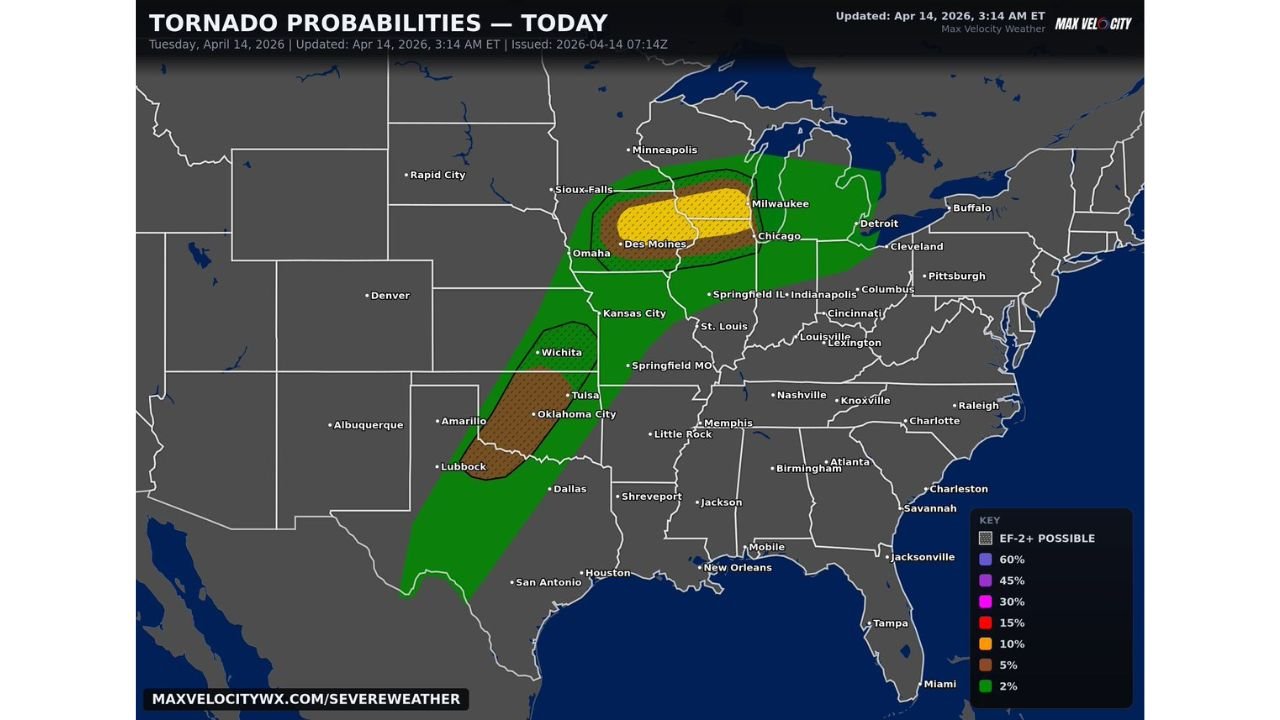
UNITED STATES — The scale of today’s tornado threat is historic. Over 45 million people are in the risk zone for tornadoes this afternoon and evening — one of the largest populations placed under a tornado threat in recent years. The tornado probability map for Tuesday April 14, 2026, updated at 3:14 AM ET and issued at 07:14Z, shows two completely separate EF-2-plus tornado corridors active simultaneously across the country — one targeting the Upper Midwest from Des Moines through Chicago and Milwaukee, and a second targeting Oklahoma City, Tulsa, Wichita, and the Southern Plains. Forecasters are delivering a direct and urgent message to all 45 million people in the risk zone: review your tornado action plan now.
Two Separate EF-2-Plus Tornado Corridors — Both Active Today
The tornado probability map defines two distinct geographic corridors where EF-2-plus tornadoes are specifically possible today — shown by the hatched shading on the map. Both corridors carry their own probability zones and their own peak danger windows.
Northern Corridor — Des Moines Through Chicago and Milwaukee
The northern EF-2-plus corridor is the higher-probability and potentially more violent of the two setups today. It is centered on the Des Moines, Chicago, and Milwaukee zone and extends across a defined oval covering the Upper Midwest.
| Probability Zone | Cities Covered — Northern Corridor |
|---|---|
| 45% probability | Core of Des Moines — highest probability on the northern corridor |
| 30% probability | Surrounding Des Moines zone — Sioux Falls, Omaha edge, inner Milwaukee area |
| 15% probability | Chicago, Milwaukee broader metro, outer Des Moines ring |
| 10% probability | Springfield IL, Indianapolis edge, Detroit, Cleveland outer zone |
| 5% probability | Minneapolis, Kansas City, Columbus, Pittsburgh edge |
| 2% probability | Broader surrounding area — Buffalo, Louisville, Lexington, Nashville outer zone |
The 45% tornado probability zone centered on Des Moines means that within 25 miles of that point, there is nearly a 1-in-2 chance of a tornado occurring today. That is an extraordinary probability for a single location on a single day and reflects the extreme atmospheric priming identified by forecasters across the Upper Midwest corridor.
Southern Corridor — Oklahoma City, Tulsa, Wichita, and the Southern Plains
The southern EF-2-plus corridor is a separate and independent tornado threat zone centered on Oklahoma City, Tulsa, and the surrounding Southern Plains — the evening mode of today’s bimodal outbreak.
| Probability Zone | Cities Covered — Southern Corridor |
|---|---|
| 10-15% probability | Oklahoma City, Tulsa — core of the southern corridor |
| 5% probability | Wichita, Amarillo outer zone |
| 2% probability | Lubbock, Dallas edge, broader Southern Plains surrounding area |
The southern corridor carries lower absolute probability values than the northern corridor, but the EF-2-plus hatching is in place — meaning violent tornado potential exists in this zone as well, and the threat ramps up during the evening hours as the low-level jet intensifies after dark.
The 45 Million People in the Risk Zone
45 million Americans placed under a tornado risk zone on a single day represents one of the largest population exposures to tornado danger in recent memory. The geographic breadth of today’s outbreak corridor — from San Antonio and Houston in south Texas northeast through Oklahoma City, Kansas City, Des Moines, Chicago, Milwaukee, and into Detroit and Cleveland — encompasses some of the most densely populated cities in the central and eastern United States.
| Major Metro Area | Population Exposure |
|---|---|
| Chicago, Illinois | Inside tornado risk zone |
| Milwaukee, Wisconsin | Inside EF-2-plus zone |
| Des Moines, Iowa | Inside 45% tornado probability zone |
| Oklahoma City, Oklahoma | Inside EF-2-plus southern corridor |
| Tulsa, Oklahoma | Inside EF-2-plus southern corridor |
| Indianapolis, Indiana | Near outer northern corridor |
| Detroit, Michigan | Near outer northern corridor |
| Cleveland, Ohio | Outer northern corridor |
| Kansas City, Missouri | Between corridors — tornado risk zone |
| St. Louis, Missouri | Outer risk zone |
| Minneapolis, Minnesota | Outer northern corridor |
| Omaha, Nebraska | Near northern corridor edge |
| Wichita, Kansas | Between corridors |
| Dallas, Texas | Southern corridor outer zone |
Full Tornado Probability Breakdown — Both Corridors Combined
| Probability | What It Means | Location |
|---|---|---|
| 45% | Nearly 1-in-2 chance of tornado within 25 miles | Des Moines, Iowa core |
| 30% | Nearly 1-in-3 chance | Inner Upper Midwest zone surrounding Des Moines |
| 15% | Better than 1-in-7 chance | Chicago, Milwaukee, outer Upper Midwest |
| 10% | 1-in-10 chance | Oklahoma City, Tulsa, Springfield IL, Indianapolis edge |
| 5% | 1-in-20 chance | Wichita, Minneapolis, Kansas City, Columbus, Pittsburgh |
| 2% | Elevated above climatological average | Broader surrounding corridor from Texas to the Great Lakes |
| EF-2+ hatched | Violent tornado specifically possible | Des Moines-Chicago-Milwaukee corridor AND Oklahoma City-Tulsa corridor |
Why 45 Million People Need to Act Right Now
Forecasters are not asking people to be generally aware of today’s threat. They are delivering four specific directives that constitute a tornado action plan for everyone in the 45-million-person risk zone:
1. Review Your Tornado Action Plan Now Not this afternoon. Not when storms approach. Right now — this morning. A tornado action plan means knowing exactly where your shelter is, exactly how you will get there, exactly what you will do if a warning drops while you are at work, at home, in your car, or at school. Every person in the risk zone needs that plan finalized before noon today.
2. Have Multiple Ways to Receive Weather Alerts One alert method is not enough in a 45-million-person tornado outbreak. Every person in the risk zone needs at minimum: a NOAA weather radio with battery backup, active county-level phone alerts from at least two different weather apps, and a trusted contact who can reach them if primary communications fail.
3. Check Your Local NWS for the Latest Updates The National Weather Service offices covering your county are issuing updates throughout the day as the tornado threat evolves. Check your local NWS office — Chicago, Des Moines, Norman, Tulsa — for the most localized and current information specific to your area.
4. Watch Live Weather Coverage for Life-Saving Information During an outbreak of this scale, continuous live severe weather coverage provides real-time warning information, storm location updates, and tornado confirmation reports that can provide additional seconds of life-saving lead time before a warning drops for your specific county.
The Two Threat Windows — Afternoon and Evening
| Corridor | Peak Threat Window | Primary Cities |
|---|---|---|
| Northern — EF-2-plus | 3 PM through 10 PM | Des Moines, Chicago, Milwaukee |
| Southern — EF-2-plus | Evening — low-level jet driven | Oklahoma City, Tulsa, Wichita |
The northern corridor’s threat window opens at 3 PM when supercells are expected to fire across eastern Iowa and northern Illinois. The southern corridor’s threat ramps up in the evening as the low-level jet intensifies and provides additional wind shear for tornado-producing supercells across Oklahoma and the Southern Plains.
Today’s 45-Million-Person Tornado Outbreak at a Glance
| Factor | Details |
|---|---|
| Valid date | Tuesday April 14, 2026 |
| Updated | April 14, 2026 at 3:14 AM ET |
| Total population at risk | Over 45 million people |
| Northern corridor peak probability | 45% — Des Moines, Iowa |
| Northern EF-2-plus zone | Des Moines, Chicago, Milwaukee |
| Southern EF-2-plus zone | Oklahoma City, Tulsa |
| Northern threat window | 3 PM to 10 PM |
| Southern threat window | Evening — ramps up with low-level jet |
| Critical actions | Review tornado plan, multiple alerts, check local NWS, watch live coverage |
45 Million People — Every One of Them Needs a Plan Before 3 PM
The largest tornado outbreak of the season is unfolding today across two separate corridors simultaneously. 45 million Americans are in the risk zone. A 45% tornado probability is centered on Des Moines. EF-2-plus violent tornadoes are possible across both the Upper Midwest and the Southern Plains. The northern corridor opens at 3 PM. The southern corridor intensifies after dark.
Every one of those 45 million people needs a tornado action plan reviewed, multiple alert methods active, their local NWS checked, and live coverage available before this afternoon’s threat window opens. The time to do all of that is right now — not at 3 PM when the supercells are already firing.
Stay with CabarrusWeekly.com for live coverage of today’s historic tornado outbreak, real-time tornado probabilities, warning updates across both the northern and southern EF-2-plus corridors, and life-saving weather information for all 45 million Americans in today’s tornado risk zone.