North Carolina Drought Worsens as Exceptional Drought Emerges for the First Time Since 2008 With 100 Percent of the State Now in Drought
NORTH CAROLINA — The drought crisis across North Carolina has deepened significantly as of the assessment period ending April 28, 2026, with Exceptional Drought (D4) now emerging across parts of the southern Piedmont for the first time since March 4, 2008. Despite some showers over the past week, conditions worsened statewide, and 100 percent of North Carolina is now in some category of drought.
The Numbers Behind the Crisis
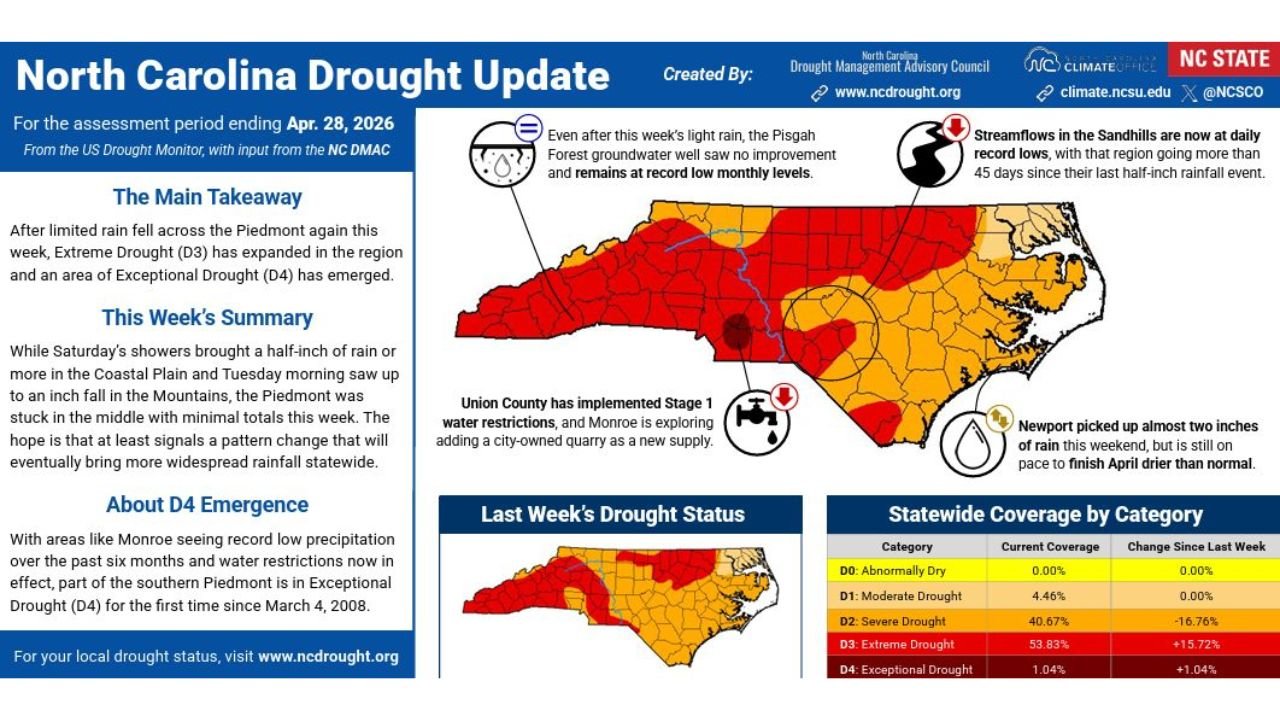
Statewide drought coverage as of April 28, 2026:
| Category | Current Coverage | Change Since Last Week |
|---|---|---|
| D1 Moderate Drought | 4.46% | 0.00% |
| D2 Severe Drought | 40.67% | -16.76% |
| D3 Extreme Drought | 53.83% | +15.72% |
| D4 Exceptional Drought | 1.04% | +1.04% |
The shift is dramatic — Extreme Drought expanded by more than 15 percent in a single week, while Exceptional Drought appeared for the first time in nearly 18 years across part of the state.
Why Conditions Worsened Despite Recent Rain
While Saturday’s showers brought a half-inch or more to parts of the Coastal Plain, and Tuesday morning brought up to an inch in the Mountains, the Piedmont was stuck in the middle with minimal totals. The problem across the state has been consistent — rainfall amounts have remained below average, and above average totals are needed to reverse the trend.
Even after this week’s light rain, the Pisgah Forest groundwater well saw no improvement and remains at record low monthly levels. Streamflows in the Sandhills are now at daily record lows, with that region going more than 45 days since their last half-inch rainfall event. Newport picked up nearly two inches of rain this weekend but is still on pace to finish April drier than normal.
Exceptional Drought Arrives in the Southern Piedmont
The D4 Exceptional Drought designation has emerged across part of the southern Piedmont, centered around areas including Monroe, which has recorded record low precipitation over the past six months. Union County has implemented Stage 1 water restrictions, and the city of Monroe is exploring adding a city-owned quarry as a new water supply to address the crisis.
This is the first appearance of Exceptional Drought in North Carolina since March 4, 2008 — making this one of the most significant drought events the state has experienced in nearly two decades.
What the Drought Map Shows
The US Drought Monitor map valid April 28, 2026 shows the depth of the crisis visually. Deep red (D3 Extreme Drought) dominates the western two-thirds of the state, covering the Mountains, Foothills, Piedmont, and much of the central region including areas around Charlotte, Greenville, and inland communities. Dark maroon (D4 Exceptional Drought) has appeared in the southern Piedmont. The eastern Coastal Plain holds the least severe drought conditions, with orange (D2 Severe Drought) and yellow (D1 Moderate Drought) across that region.
What It Will Take to Turn This Around
The pattern of below average rainfall must shift to above average totals to begin reversing the drought. Upcoming rain chances offer some hope of a better pattern developing, but the depth of the current drought means recovery will require a sustained period of well above average precipitation across the state — particularly across the Piedmont and western regions where conditions are most extreme.
Stay with CabarrusWeekly.com for continuing updates on the North Carolina drought situation and incoming rainfall chances.