Carolinas and Virginia Need 16 to 22 Inches of Rain to End Drought But Chances of Recovery by July Stay Below 27 Percent
CAROLINAS — The drought gripping the Carolinas and surrounding region has reached a level of severity that a few storms or even a rainy weekend cannot fix, with data showing cities across North Carolina, South Carolina, and Virginia need 16 to 22 inches of rainfall over the next three months just to end the drought by July — and the probability of that actually happening tops out at just 27 percent even in the most optimistic locations.
16 to 22 Inches Needed Across the Carolinas and Virginia
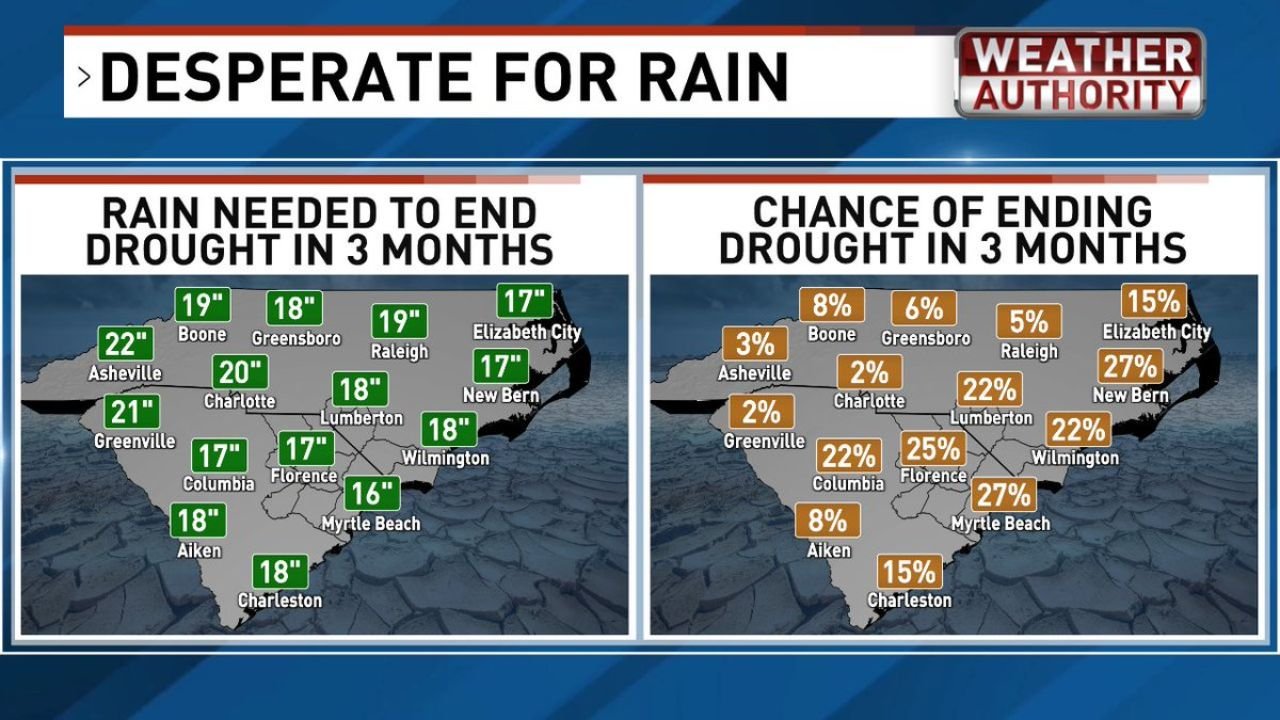
Rainfall deficit data shows just how deep the drought hole has become across the region. Asheville needs 22 inches, Greenville 21 inches, Charlotte 20 inches, and Columbia and Raleigh each need 19 inches of total rainfall over the next three months — a figure that includes both the current rainfall deficit and the assumption that near-normal precipitation falls through July. Coastal communities face slightly lower but still daunting totals, with Wilmington needing 18 inches, Myrtle Beach 16 inches, New Bern 17 inches, and Elizabeth City 17 inches.
| City | Rain Needed in 3 Months |
|---|---|
| Asheville, NC | 22 inches |
| Greenville, SC | 21 inches |
| Charlotte, NC | 20 inches |
| Columbia, SC | 19 inches |
| Raleigh, NC | 19 inches |
| Lumberton, NC | 18 inches |
| Wilmington, NC | 18 inches |
| Aiken, SC | 18 inches |
| Charleston, SC | 18 inches |
| New Bern, NC | 17 inches |
| Florence, SC | 17 inches |
| Elizabeth City, NC | 17 inches |
| Myrtle Beach, SC | 16 inches |
Chances of Ending Drought by July Dismally Low
Even more sobering than the rainfall totals needed is the probability of actually achieving them. Across the western Carolinas and upstate South Carolina, the chance of ending the drought within three months sits at just 2 to 8 percent — near statistical impossibility. Asheville carries only a 3 percent chance, Charlotte just 2 percent, and Greenville and Columbia each at 2 and 22 percent respectively.
Coastal areas fare somewhat better but still offer little hope. New Bern carries the highest probability at 27 percent, followed by Myrtle Beach and Florence both at 27 and 25 percent, and Wilmington at 22 percent. Even these relatively higher coastal probabilities still mean the drought is more likely than not to persist well beyond July across the entire region.
Five Factors Determining Whether Drought Recovery Is Possible
Ending a drought of this magnitude requires more than a few good storms. Five key factors determine whether recovery is achievable across the Carolinas over the next three months — long-range forecast models showing sustained above-normal rainfall, the seasonal shift from spring to summer which makes widespread rain less frequent, the current depth and severity of the drought itself, how far behind the region already sits on its rainfall deficit, and historical precedent from similar drought setups.
It takes consistent, soaking rainfall over weeks and months — not isolated storm events — to meaningfully reduce a drought of this depth. With summer’s more scattered and unreliable rainfall pattern approaching, the window for widespread drought-busting precipitation is narrowing rapidly.
Stay with CabarrusWeekly.com for continuing drought and rainfall deficit updates across the Carolinas and Southeast through the summer.