
Full Moon Lunar Eclipse Aligns with Mercury and Venus Conjunctions on March 3–4, 2026, Raising Questions About Planetary Geometry and Seismic Activity
UNITED STATES — An upcoming Full Moon lunar eclipse on March 3–4, 2026 is drawing attention not only for its visual impact in the night sky, but also for a rare clustering of planetary alignments occurring within hours of the eclipse.
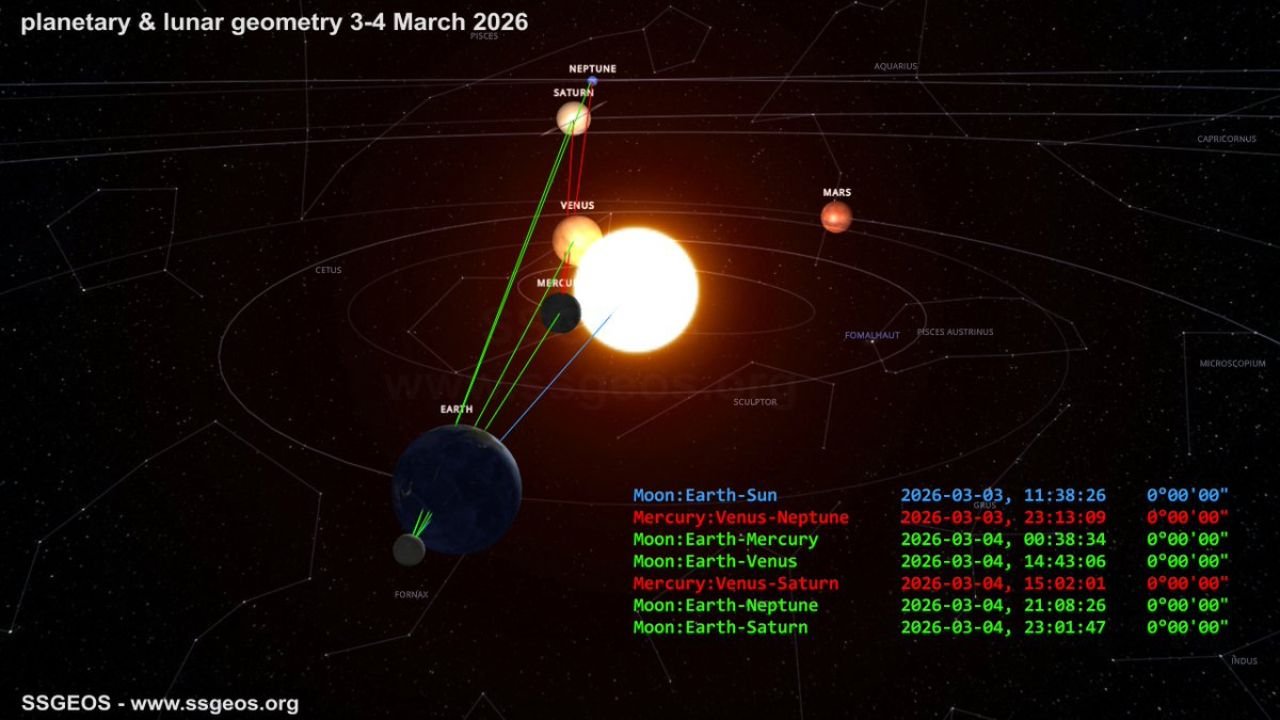
Astronomical charts for March 3–4 show multiple near-perfect conjunctions involving Mercury, Venus, Neptune, Saturn, the Moon, Earth and the Sun — creating what some researchers describe as notable planetary and lunar geometry.
Key Alignments Occurring Within Hours
According to the planetary configuration timeline for March 3–4, 2026, the following alignments occur in rapid succession:
- Moon–Earth–Sun alignment (Full Moon / Lunar Eclipse) – March 3
- Mercury–Venus–Neptune conjunction – March 3
- Moon–Earth–Mercury alignment – March 4
- Moon–Earth–Venus alignment – March 4
- Mercury–Venus–Saturn conjunction – March 4
- Moon–Earth–Neptune alignment – March 4
- Moon–Earth–Saturn alignment – March 4
The clustering of these alignments within roughly a 24-hour window is what makes this period stand out astronomically.
What Is Happening During the Lunar Eclipse?
A lunar eclipse occurs when the Earth moves directly between the Sun and the Moon, casting Earth’s shadow across the Moon’s surface. This can only happen during a Full Moon.
On March 3, 2026, the Moon, Earth and Sun will form a near-straight line — a geometry known as syzygy. During this alignment, gravitational forces from the Sun and Moon combine, producing stronger-than-average tidal forces on Earth.
Mercury and Venus Conjunctions Add to the Geometry
At nearly the same time, Mercury and Venus align with outer planets including Neptune and Saturn, forming additional straight-line geometries in the inner solar system.
The charts show these planets positioned closely along similar orbital lines relative to Earth and the Sun.
While such conjunctions are not unheard of, the simultaneous occurrence of multiple alignments centered around a Full Moon eclipse is less common.
The Seismic Activity Question
Some independent research groups monitor planetary alignments for potential correlations with increased seismic activity. The theory suggests that when gravitational forces align, stress redistribution along Earth’s tectonic plates could be marginally influenced.
However, mainstream scientific consensus maintains that:
- Tectonic plate motion is driven primarily by internal Earth processes
- Gravitational forces from planetary alignments are relatively small compared to those forces
There is no established scientific agreement that planetary conjunctions directly trigger earthquakes. Still, periods of strong lunar and solar alignment — especially during Full and New Moons — are sometimes studied for statistical patterns.
What This Means for North Carolina
For residents of North Carolina, including Cabarrus County, the primary observable impact of this event will be the lunar eclipse itself, which should be visible depending on local weather conditions.
While discussions around seismic potential continue in certain research circles, there is currently no official forecast indicating specific earthquake activity tied to this event.
Looking Ahead
March 3–4, 2026 will present:
- A Full Moon lunar eclipse
- Multiple Mercury and Venus conjunctions
- A rare clustering of planetary alignments within a short time frame
Whether viewed purely as an astronomical event or examined through broader geophysical lenses, it will be a noteworthy period in early March.
CabarrusWeekly.com will continue tracking both astronomical events and Earth science developments as this unique planetary configuration approaches.