Severe-to-Extreme Drought Is Tightening Its Grip on the Carolinas and the Southeast — And the Next 10 Days Offer Almost No Relief as Soils Hit Crisis Levels Across Charlotte, Raleigh, Columbia, and Beyond
CHARLOTTE, NORTH CAROLINA — The drought gripping the Carolinas and surrounding Southeast is not just continuing — it is about to get significantly worse. Already sitting at severe-to-extreme drought status, the region is entering a 10-day stretch with virtually no meaningful rainfall on the way, soil moisture at historically low levels, and wildfire risk climbing as drying vegetation adds fuel to an already dangerous situation.
The Drought Is Already Severe — and It Is About to Deepen
Conditions across North Carolina, South Carolina, and the broader Southeast have deteriorated to a point that forecasters are now warning will worsen significantly over the next 10 days. The region is not approaching severe-to-extreme drought — it is already there, and the trajectory is pointing in the wrong direction with no corrective rainfall in the immediate forecast.
Soil moisture is plummeting. Vegetation is continuing to grow despite the lack of rainfall, which means plants are pulling whatever remaining moisture exists out of already depleted soils at an accelerating rate. That combination — growing vegetation, zero rain, and rapidly falling soil moisture — is a recipe for conditions to deteriorate faster than the calendar alone would suggest.
What the Soil Moisture Data Shows Across the Region
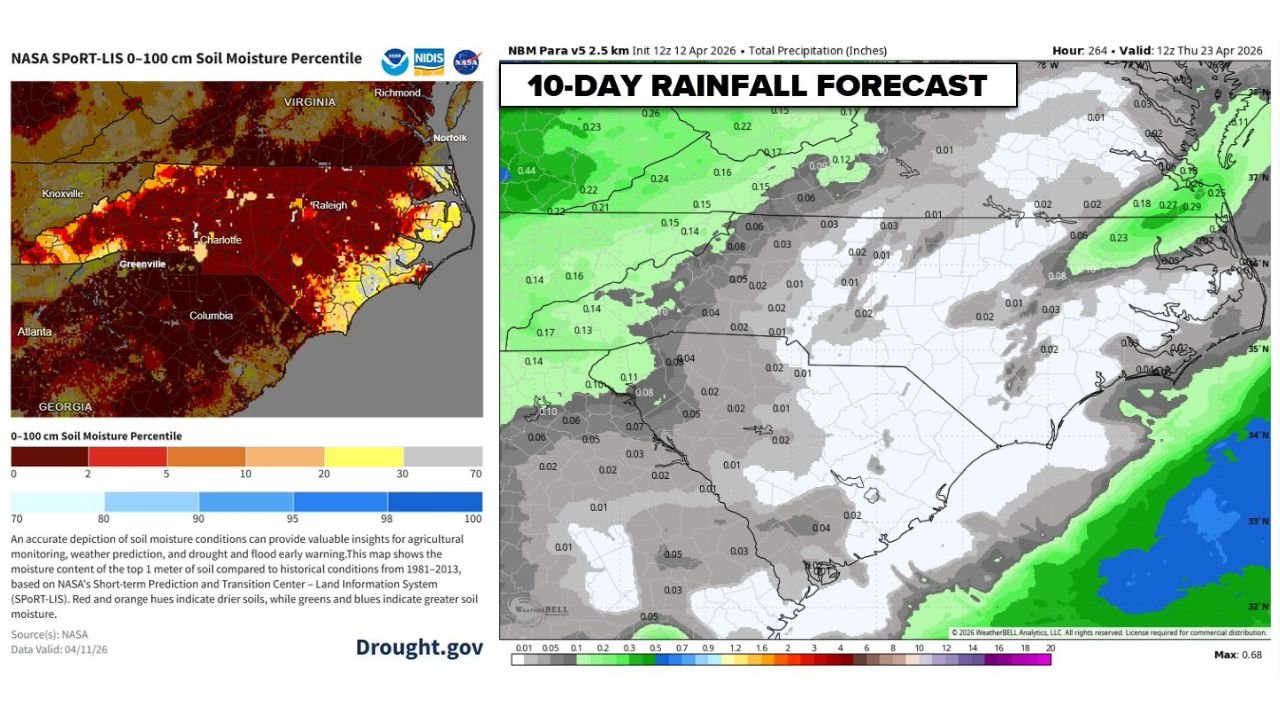
The NASA SPoRT-LIS soil moisture map, valid April 11, 2026, measuring the top 1 meter of soil compared to historical conditions from 1981 through 2013, paints one of the most alarming pictures of the current drought’s severity.
| Area | Soil Moisture Percentile | Condition |
|---|---|---|
| Charlotte and surrounding Piedmont | 0 to 2 percentile | Exceptional dryness |
| Raleigh and central North Carolina | 0 to 5 percentile | Extreme to exceptional dryness |
| Greenville, South Carolina | 0 to 5 percentile | Extreme to exceptional dryness |
| Columbia, South Carolina | 2 to 10 percentile | Severe to extreme dryness |
| Western North Carolina near Knoxville | 5 to 20 percentile | Moderate to severe dryness |
| Coastal North Carolina near Norfolk and Richmond | 10 to 30 percentile | Moderate dryness |
The darkest red and brown colors dominate the map across the heart of the Carolinas. Charlotte, Raleigh, Greenville, and Columbia are sitting at soil moisture levels in the bottom 0 to 5 percent of all recorded conditions going back over four decades. That is not just dry — that is historically dry for this time of year.
10 Days of Rainfall Forecast: The Numbers Are Nearly Zero
The NBM Para v5 2.5 km 10-day rainfall forecast, initialized 12z April 12, 2026 and valid through 12z Thursday April 23, 2026, confirms what the drought map suggests — meaningful relief is not coming.
| Area | 10-Day Rainfall Forecast |
|---|---|
| Charlotte, NC | 0.02 to 0.04 inches |
| Raleigh, NC | 0.01 to 0.03 inches |
| Central North Carolina | 0.01 to 0.03 inches |
| Columbia, SC | 0.01 to 0.05 inches |
| Greenville, SC | 0.05 to 0.11 inches |
| Western NC mountains | 0.08 to 0.17 inches |
| Coastal NC near Outer Banks | 0.18 to 0.29 inches |
| Far western Virginia | 0.15 to 0.26 inches |
Charlotte and Raleigh are looking at trace to near-zero rainfall over the entire next 10 days. The most drought-stressed areas in the heart of the Carolinas are also the areas receiving the least projected rainfall. What little moisture does fall stays on the fringes — the mountains to the west and the coast to the east — while the drought-stricken Piedmont and interior regions remain almost completely dry through April 23.
Wildfire Danger Is Rising and Will Continue to Rise
With soil moisture at historic lows, vegetation actively growing and drying out simultaneously, and no rainfall on the way, wildfire risk across the Carolinas and surrounding Southeast is elevated and heading higher.
Dry vegetation is adding fuel to the landscape at exactly the wrong time. As temperatures warm and humidity drops through the coming days, the conditions needed for rapid fire spread will become increasingly favorable across the region. Residents across North Carolina, South Carolina, and neighboring areas should be treating outdoor burning with extreme caution and following any burn bans or restrictions issued by local authorities.
What You Can Do Right Now
With drought conditions worsening and no relief in the immediate forecast, water conservation is not optional — it is necessary. Key actions for residents across the affected region:
- Water landscapes, gardens, and plants early in the morning or late in the evening to maximize effectiveness and reduce evaporation loss
- Spot-water only where needed rather than broad irrigation to stretch available water as far as possible
- Conserve household water use wherever possible as drought stress on local water supplies increases
- Avoid any outdoor burning given the elevated and rising wildfire risk across the region
The Drought Outlook for the Carolinas Through April 23
| Factor | Current Status |
|---|---|
| Drought level | Severe to extreme across the Carolinas |
| Soil moisture — Charlotte and Raleigh | Bottom 0 to 2 percentile historically |
| 10-day rainfall — Charlotte | 0.02 to 0.04 inches total |
| 10-day rainfall — Raleigh | 0.01 to 0.03 inches total |
| Wildfire risk | High and rising as vegetation dries |
| Drought trend next 10 days | Worsening significantly |
No Quick Fix Is Coming for the Carolinas
The data is clear and the message is difficult — the drought across Charlotte, Raleigh, Greenville, Columbia, and the broader Carolina region is going to get worse before it gets better. Soil moisture levels that are already in the bottom percentile of recorded history are about to face 10 more days of heat, sun, growing vegetation, and near-zero rainfall.
The combination of severe-to-extreme drought, historically depleted soils, rising wildfire danger, and an empty rainfall forecast through April 23 makes this one of the most serious drought situations the Carolinas have seen in years. Residents, farmers, and land managers across the region need to be taking this seriously right now.
Stay with CabarrusWeekly.com for ongoing drought coverage, wildfire risk updates, and the latest rainfall forecasts for Charlotte, the Carolinas, and the surrounding Southeast.