15 Years Ago the April 25 to 28 2011 Super Outbreak Killed 324 People Across the South and Remains One of the Deadliest Tornado Disasters in United States History
UNITED STATES — Fifteen years ago this week, one of the most catastrophic severe weather events in recorded history unfolded across the eastern United States. The April 25 to 28, 2011 Super Outbreak produced 368 confirmed tornadoes, killed 324 people, injured more than 3,100 others, and caused an estimated 12 billion dollars in damage — a four-day sequence that forever changed how Americans understand tornado risk.
The Numbers That Define a Catastrophe
The scale of the 2011 Super Outbreak remains almost incomprehensible even 15 years later:
| Statistic | Total |
|---|---|
| Total confirmed tornadoes | 368 |
| Tornadoes in a single 24-hour period | 224 |
| EF5 tornadoes | 4 |
| Deaths | 324 |
| Injuries | 3,100-plus |
| Estimated damage | 12 billion dollars |
| Deadly tornadoes | 31 confirmed |
224 tornadoes in a single 24-hour period — a number that alone stands as one of the most staggering single-day tornado totals ever recorded in United States history.
Day One Began in Arkansas on April 25
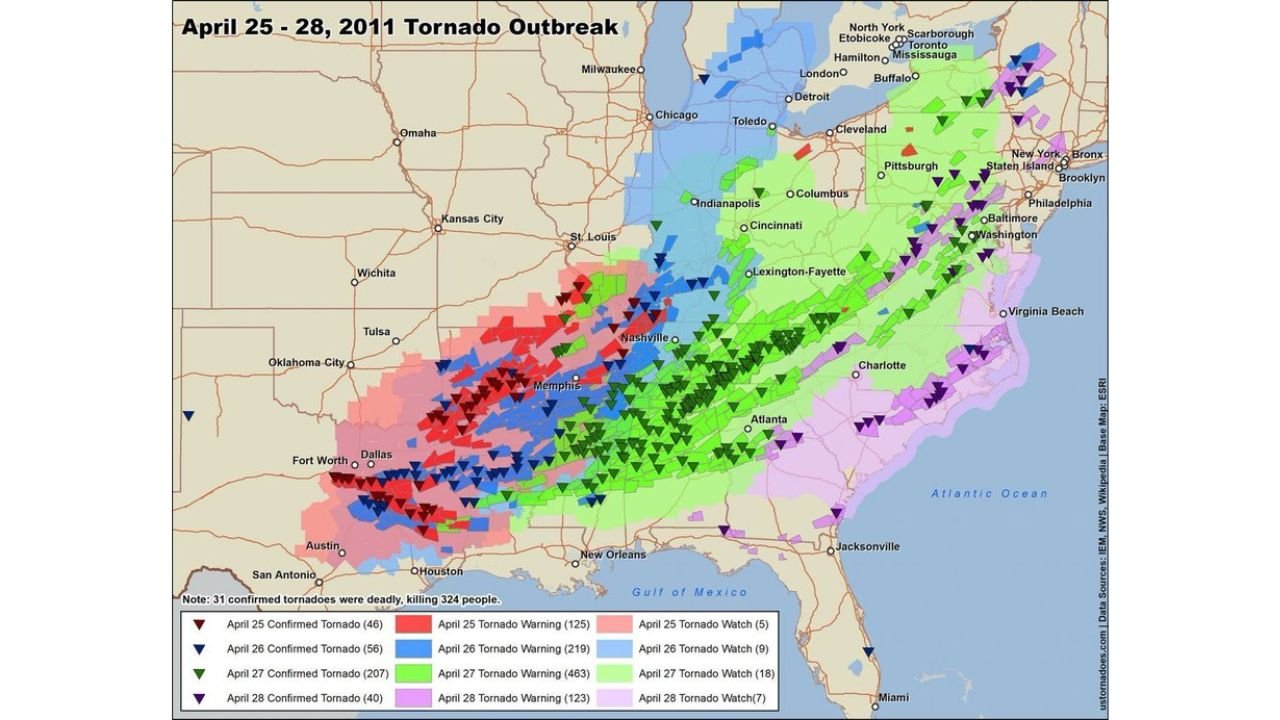
The outbreak began on April 25, 2011, with 46 confirmed tornadoes touching down and 125 tornado warnings issued across the region. Arkansas bore the brunt of Day 1, with multiple significant tornadoes carving paths across the state.
Four notable tornadoes struck Arkansas on April 25:
| Tornado | Rating | Path |
|---|---|---|
| Walnut Valley to Hot Springs Village | EF3 | Hot Spring and Garland counties |
| Bear Lake to Ouachita State Park | EF2 | Hot Spring and Montgomery counties |
| Little Rock Air Force Base | EF2 | Pulaski County |
| Vilonia | EF2 | Faulkner and White counties — long track northeast of Conway |
The Vilonia EF2 tracked a long path northeast through Faulkner County, passing near Conway before ending northeast of the city — a preview of the destruction that Vilonia would tragically experience again just three years later in 2014.
Four Days of Relentless Destruction
The outbreak did not end on April 25. It escalated dramatically through the following days:
| Day | Confirmed Tornadoes | Tornado Warnings Issued |
|---|---|---|
| April 25 | 46 | 125 |
| April 26 | 56 | 219 |
| April 27 | 207 | 463 |
| April 28 | 40 | 123 |
April 27 alone produced 207 confirmed tornadoes and 463 tornado warnings — the single most active tornado day in recorded United States history. Four EF5 tornadoes touched down across Alabama on that date, including the Hackleburg-Phil Campbell and Tuscaloosa-Birmingham tornadoes.
A Footprint That Stretched Across the Entire East
The tornado tracks map shows the staggering geographic reach of this outbreak. Tornadoes were confirmed from Texas and Oklahoma in the west through Tennessee, Alabama, Mississippi, and Georgia, and all the way to the Mid-Atlantic and New England states in the east. The outbreak was not a regional event — it was a national catastrophe that touched communities from the Gulf Coast to the Canadian border.
What April 25 to 28 2011 Changed Forever
The 2011 Super Outbreak forced a fundamental reassessment of tornado preparedness, warning communication, and shelter infrastructure across the United States. It demonstrated that no single community, no matter how tornado-aware, is fully immune when atmospheric conditions align at this scale.
As severe weather season reaches its most active period in 2026, the anniversary of the 2011 outbreak serves as a powerful reminder of what is at stake — and why preparation, shelter planning, and taking every tornado warning seriously can mean the difference between life and death.
Stay with CabarrusWeekly.com for continuing severe weather coverage throughout the 2026 spring storm season.