Wettest Stretch Since 1893 Drowns the Midwest While the South Bakes Through One of the Driest and Hottest Periods on Record
UNITED STATES — The period from March 1 through April 19, 2026 has produced one of the most historically extreme weather contrasts ever recorded across the United States — with the Midwest and Great Lakes logging their wettest stretch since 1893, while the central Plains and Southeastern US simultaneously endured one of the driest periods in 134 years of records, all during what ranks as one of the warmest March-April stretches in recorded history.
Midwest and Great Lakes Shatter 133-Year Precipitation Records
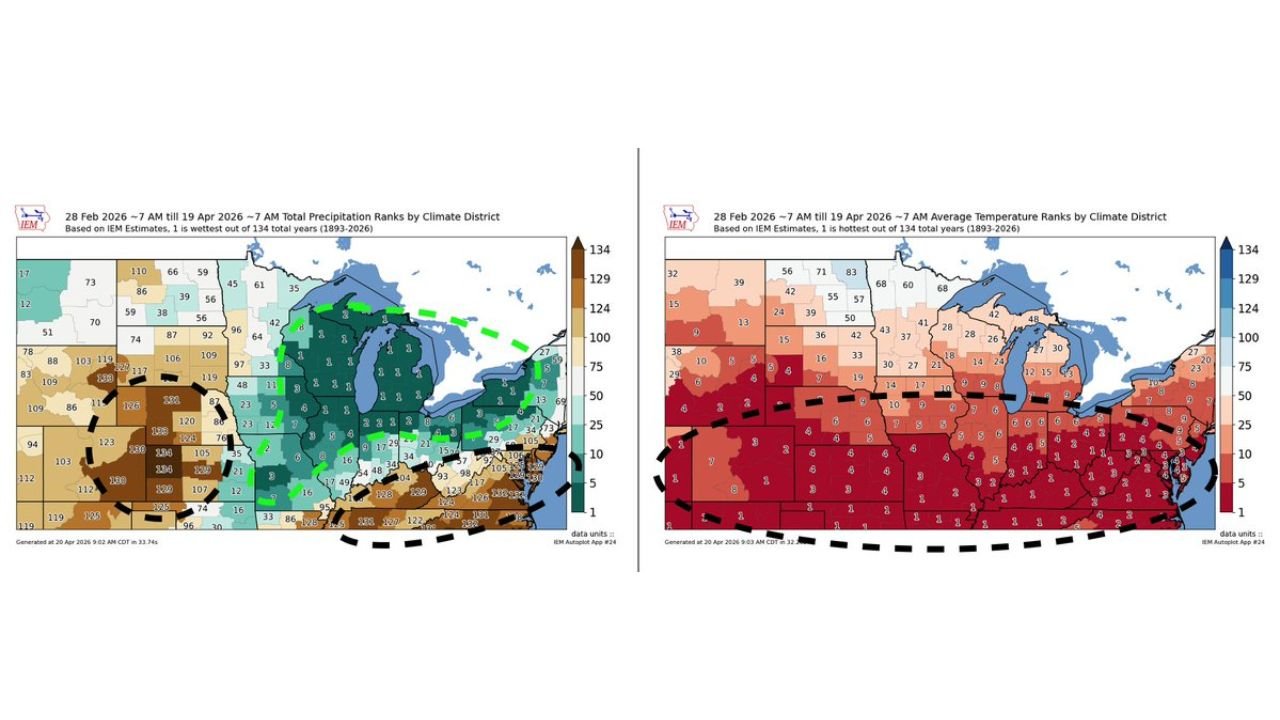
Precipitation rank data covering 134 years of records from 1893 through 2026 shows an extraordinary cluster of rank-1 and rank-2 wettest readings — meaning the absolute wettest or second wettest on record — blanketing Michigan, Wisconsin, Indiana, Ohio, and surrounding Great Lakes climate districts. Multiple climate districts across the core of the Great Lakes region rank number 1 out of 134 years for total precipitation during this period.
The wettest footprint extends from the Upper Great Lakes southward through Illinois and into the Ohio Valley, with precipitation ranks of 1 through 10 — representing the top 7 percent of all years on record — covering an enormous multi-state zone.
Central Plains and Southeast Hit With One of the Driest Periods Ever
In stark and dramatic contrast, climate districts across the central Plains — including Kansas, Oklahoma, and surrounding areas — rank 119 to 134 out of 134 years for precipitation, placing them among the absolute driest readings in the entire 134-year dataset. Several districts across the Southern Plains rank 134 out of 134 — meaning this is literally the driest such period ever recorded in those locations.
The drought footprint extends into the Southeastern United States, where precipitation ranks across portions of the region also fall into historically dry territory during the same March 1 through April 19 window.
Simultaneously One of the Warmest Periods in Recorded History
Temperature rank data for the same period tells an equally striking story. Climate districts across a massive corridor from the Southern Plains through the Midwest, Ohio Valley, and into the Mid-Atlantic are ranked 1 through 6 out of 134 years for average temperature — placing this stretch among the absolute hottest March-April periods ever recorded across a large portion of the eastern United States.
Ranks of 1 through 5 — the top 4 percent of all years — are concentrated across Texas, Oklahoma, Arkansas, Missouri, Illinois, Indiana, Ohio, Kentucky, Tennessee, and the Mid-Atlantic states.
| Metric | Record Status | Most Extreme Region |
|---|---|---|
| Midwest/Great Lakes Precipitation | Wettest since 1893 — Rank 1 to 2 out of 134 | Michigan, Wisconsin, Indiana, Ohio |
| Central Plains Precipitation | One of driest ever — Rank 119 to 134 out of 134 | Kansas, Oklahoma, Southern Plains |
| Southeast Precipitation | Historically dry | Portions of SE United States |
| Average Temperature — Eastern US | One of hottest ever — Rank 1 to 6 out of 134 | TX, OK, AR, MO, IL, IN, OH, Mid-Atlantic |
A Historic Split Pattern Rarely Seen in the Instrumental Record
The simultaneous occurrence of record wetness in the Great Lakes, record dryness across the Plains and Southeast, and record warmth across the eastern half of the country within the same 7-week window represents an extraordinarily rare atmospheric configuration. Such extreme contrasts occurring concurrently across adjacent regions push the boundaries of what the 134-year instrumental record has documented for the March through April period.
Stay with CabarrusWeekly.com for continuing coverage of historic weather patterns and climate extremes across the United States.